 The AMI QT devotionals from Feb. 6-12 are provided by Cami King. Cami, a graduate of University of Pennsylvania, recently completed her M.Div. at Gordon Conwell Seminary. She is currently serving as a staff at Journey Community Church in Raleigh.
DEVOTIONAL THOUGHT FOR TODAY
Living With Purpose
1 Corinthians 1:1-3
Paul, called as an apostle of Jesus Christ by the will of God, and Sosthenes our brother, 2 To the church of God which is at Corinth, to those who have been sanctified in Christ Jesus, saints by calling, with all who in every place call on the name of our Lord Jesus Christ, their Lord and ours: 3 Grace to you and peace from God our Father and the Lord Jesus Christ.
 I never skip an opportunity to draw attention to the salutations in Paul’s letters. They are some of my favorite parts in all his writings, because they are usually so loaded with theological significance and remind us of the importance of identity. Our identity is the source and foundation for all we say and do. And as believers, remembering who we are in Christ is imperative to not only living as Kingdom People but also to doing Kingdom work. In today’s passage, Paul reminds us that we are sanctified by the blood of Jesus, knitted together as one family, and given a calling (as saints, and more specifically for Paul, as an apostle)! Being called God’s own people gives us a glorious identity and purpose.
My small group is going through Rick Warren’s The Purpose Driven Life together, where we are exploring the question, “What on earth am I here for?” During the first week’s readings (there is a short chapter to read each day) I was reminded just how easy it is for me to go through any given day without giving much thought to who I really am and what I’m here to do. Identity and purpose go hand and hand and both require intentionality. Living into my true identity as a child of God and living out my God-given purpose won’t happen incidentally or accidentally (or as Pastor Rick would say – The only way to live with purpose is on purpose).
How often do you think about who you are and what you’re here to do? I was challenged recently to start each day with intentionality by reminding myself every morning of who I am and what I’m on earth to do. You should try it! As we do this over and over, we learn to lean into all that it means to be a child of God and are empowered to make the most of every opportunity to do Kingdom work in the community around us.
Prayer: Lord, thank You for calling me Your own through the finished work of Jesus. Thank you for giving me a purpose and allowing me to participate in bringing forth Your Kingdom. Help me today to walk more fully in my identity as Your child and to live out more intentionally Your purposes for my life. In Jesus’ name. Amen.
Bible Reading for Today: Judges 16
LUNCH BREAK STUDY
Read 1 Peter 1:13-21: Therefore, preparing your minds for action, and being sober-minded, set your hope fully on the grace that will be brought to you at the revelation of Jesus Christ.14 As obedient children, do not be conformed to the passions of your former ignorance, 15 but as he who called you is holy, you also be holy in all your conduct,16 since it is written, “You shall be holy, for I am holy.” 17 And if you call on him as Father who judges impartially according to each one’s deeds, conduct yourselves with fear throughout the time of your exile, 18 knowing that you were ransomed from the futile ways inherited from your forefathers, not with perishable things such as silver or gold, 19 but with the precious blood of Christ, like that of a lamb without blemish or spot. 20 He was foreknown before the foundation of the world but was made manifest in the last times for the sake of you 21 who through him are believers in God, who raised him from the dead and gave him glory, so that your faith and hope are in God.
Questions to Consider
- In what ways does Peter remind us of the importance of being intentional with how we live each day?
- On what foundation is Peter encouraging us to carry out his instructions in this passage(vv. 17-18)? Why is this important to keep in mind?
- What might it look like for you personally to put this passage into practice in your life? What is one practical step you can take today toward that end?
Notes
- Peter encourages us to prepare (our minds for actions), to be sober-minded, and to set our hope fully on the grace of Christ. All these things are actions that require intentionality. They won’t just happen on their own.
- Peter reminds us that we are God’s own children and that we were ransomed by the precious and imperishable blood of Jesus Christ. This identity has to be at the foundation of all we do. If we forget it, we will quickly lose sight of our purpose and lack the power to complete our mission.
- Spend some time in personal reflection.
EVENING REFLECTION
“I’ve always wanted to be somebody, but I see now I should have been more specific.”
(Lily Tomlin in The Search for Signs of Intelligent Life in the Universe, by Jane Wagner)
If we’re not careful to remember our God-given identity and purpose, we’ll end up becoming someone entirely different and doing things that in the end leave us feeling unfulfilled.
Have you ever lost sight of your identity in Christ? Have you ever lost sight of the mission of God in your life? What was the result?
Spend some time articulating in your own words your identity and purpose as you understand them from Scripture. (e.g. I am [fill in the blank] and I am here to [fill in the blank].) Write it down somewhere and return to it often so you can be sure to live each day with purpose.
 The AMI QT Devotionals for February 4-5 are provided Jasmin Izumikawa. She is a member of the Church of Southland and is currently a high school teacher. She has lived the miracle of healing through the prayers of her AMI church family through her battle with lymphoma.
 Recently, our drought in California had been broken for a few gloriously rainy days. As nice as it was to have the rain, driving on the road was dangerous. Roads were flooded and my windshield wipers were not doing much to clear my view from the penetrating rain. Larger vehicles would splash waves of water onto my windshield, blocking my vision for a few seconds at a time. It felt like being in a carwash but at 45 miles an hour! It occurred to me that the most frightening thing about driving in the rain was not so much sliding around but the lack of peripheral vision around me.
 The AMI QT Devotionals for February 4-5 are provided Jasmin Izumikawa. She is a member of the Church of Southland and is currently a high school teacher. She has lived the miracle of healing through the prayers of her AMI church family through her battle with lymphoma.
 Waking up in the mornings was easy to do when I was home recovering from chemo, because I barely slept at all. Those days of silence were spent in countless sleepless hours late into the night and into the early morning. Although I was finally finished with treatments, I had little to celebrate in my heart. Sorrow had silenced me for many months. So in the days and weeks to come, I spent my sleepless nights staring at the ceiling and watching the light from passing cars sweep across my dark room until it was morning again.
 The AMI QT Devotionals from February 2-3 are provided by Pastor Mark Chun of Radiance Christian Church in S. F. Mark, a graduate of University of California, San Diego, and Talbot School of Theology (M.Div.), has been married to Mira for 20 years; they have two children, Jeremiah and Carissa.
  This philosophy stems from the ideas of Margaret Sanger, who was the original founder of Planned Parenthood. Sanger wrote that women are enslaved through their reproductive powers by men who dictate and control the standards of sex and morality. “No woman” she said, “can call herself free who does not own and control her own body. No woman can call herself free until she can choose consciously whether she will or will not be a mother.” This seems eerily close to the reasoning that Ahaz must of have had when deciding to sacrifice his own son. For power and control, there was no price he was not willing to pay.
 While I squirmed over having to present a morning devotional based on a passage dealing with infanticide, we, as followers of a holy God, need to deal with the horrifying nature of sin head on.
 When “Jorge”—originally from Puerto Rico—saw me jogging in Chester Park this December, he was happy to see me, since we hadn’t seen each other for over three years—I had moved away from that neighborhood. As we were chatting, my ears perked up when Jorge, a naturalized citizen who has long retired, said that he voted for Trump, since only a quarter of Hispanics voted for Trump. Seeing my surprised reaction, he added, “I was going to vote for Clinton, until the third debate made me realize that her position could make any abortion legal at any point during a pregnancy.” Then it dawned on me that most foreign-born Hispanics (i.e., immigrants), certainly more religious than the general population, are socially more conservative. About 60 percent of them (PEW Research Center 2014), perhaps still bearing the influence of Catholicism, continue to hold that what’s inside the womb is life.
 One can be tempted to think that justice is synonymous with “social justice,” that it is all about maintaining fair social and political relations. But in Christianity, the primary aspect of justice is about how the individual relates to God; the word “justification,” which is at the heart of salvation, is just another form of the Greek word for “justice.” Christian justice is mainly about how a person can be made right before God, which is through faith in divine grace and exemplified by good works.
 In our world, there seems to be a new name above all names, the purpose above all purposes—the almighty ideal of social justice. It would be troublesome, however, if social justice is viewed in the same light as the saying, “One man’s art is another man’s pornography.” Yet there have been many different conceptions of justice throughout the ages. Thrasymachus in Plato’s Republic says that justice is simply whatever the strongest in society have deemed to be just (“Might makes right”). The 18th century philosopher David Hume said that justice is a human convention invented for the collective self-interest. Popular, contemporary theories of social justice revolve around ending the oppression of identity-categorized minorities based on race, gender, and sexuality.
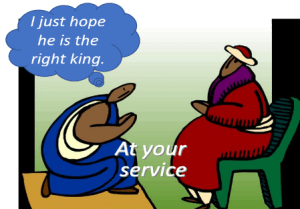 Somebody is terribly mistaken here! As Isaiah 1:17 indicates, a desire for justice is good, but if predicated on a reckless theory of justice, such passion can be a great force for injustice. We can have all the fervor of a patriotic warrior as we march off to the grand, glorious war for social justice, but if we have pledged allegiance to the wrong ideological king, we may find ourselves making the nations much worse off. An earnest search for wisdom, knowledge, and God’s justice can go a long way toward making sure our social justice arrows hit the right targets.
 The AMI QT Devotionals for January 28-29 are provided by Joanna Tzen. Joanna graduated from U. Penn and currently works in Philadelphia. She married Paul in 2014, and they attend Grace Covenant Church.
 Yesterday, we talked about Sabbath, but maybe there is the question of whether this is even necessary, practical, or applicable in today’s world. I know that in my own life, there were instances where I misinterpreted the need for Sabbath as a weakness. Clearly, I was equating my worth to my productivity. So if I saw a need or an opportunity was presented, I quickly accepted. Though some good still came out of those decisions, it often came at the greater expense of my relationship with God or others, or other priorities to which I was committed.
 I’ve been reading a book titled Emotionally Healthy Leader, where the author interestingly brings up the topic of the Sabbath. So what exactly is a Sabbath? Is it an Old Testament practice that we no longer observe as Christians?