Pastor Ryun Chang (AMI Teaching Pastor, Ph.D.) will present a series of blogs, dealing with various issues raised in the recent election that showed a deep divide, impacting both society at large and the church. The thoughts presented are processed through the lens of the Radical-Middle (both/and), personal narratives, and pastoral concerns. Your rational feedback is welcomed.
Disclaimer: The views expressed here do not necessarily represent the respective views of AMI pastors.
DEVOTIONAL THOUGHT FOR TODAY
Our Brothers Who are Easily Forgotten in the Israeli-Palestinian Conflict
Hebrews 11:10 (NIV)
For [Abraham] was looking forward to the city with foundations, whose architect and builder is God.
 The recent United Nations Security Council’s resolution to condemn Israeli settlement in territories taken during the Six-Day War (1967) continues to stir passion on both sides. While U.S. support for Israel may not be what it used to be, Christians who believe in the literal fulfillment of end-time prophecies are squarely on the side of Israel. Yet, in the midst of this bitter conflict, we have forgotten a people whom the believers have more in common with than the Israelis.
 In 2015, while attending a conference on theological education in Turkey, I befriended a theological educator named Jiries from Jordan. He is a Palestinian. Never having met a Palestinian Christian before, I cautiously asked, “How do you feel about American Christians unilaterally supporting Israel?” Jiries answered, “It’s a matter of human interpretation of the Bible on the one hand, and God’s justice on the other.” I understood what he meant by “human interpretation,” but since I didn’t get the justice part, I asked for an explanation. The following is his story.
“I was born in Lydda[1] (Lod) near Tel Aviv in 1944—four years before the establishment of Israel as a state in Palestine. In Nov. 1947, the United Nations divided Palestine into Arab state and Jewish state; Lydda was in the part allocated to the Palestinian Arab state. In July 1948, because the Israelis took control of Lydda and expelled its population, my family, including my pregnant mother and three children under the age of four, left home on foot. Walking several hours and spending the night in the open air, we met Jordanian soldiers, who took us to a small town in the remaining part of Palestine. Since then, I’ve lived in Jordan—and I can’t go back to my home and my land. Where is justice in that?”
I had no response; in fact, moved by what this brother said, I promised to share the plight of Palestinian Christians in an ensuing conference in Hong Kong, where I was scheduled to speak. But while preparing for the message, I suddenly felt this urge to share what I believed the Spirit placed in my heart. So, in an email I wrote: “Jiries, ultimately you know that this is not our home, for we are ‘aliens and strangers on earth. People who say such things show that they are looking for a country of their own. If they had been thinking of the country they had left, they would have had opportunity to return. Instead, they were longing for a better country—a heavenly one’ (Heb. 11:13-6). Of all people, you must know this better than anyone else.” Jiries later wrote me back, saying, “Thank you for your interest and being fair. Blessings.”
This blog isn’t about political policy but spiritual tension that demands Christ’s followers to move from either/or to both/and. First, the needs of the Palestinian brothers in Christ shouldn’t be ignored, since we are commanded to “do good to all people, especially to those who belong to the family of believers” (Gal. 6:10). So, while they wait for “a better country—a heavenly one,” we pray that safe places are found for them to raise their families.
What about Israel? Jiries, in a later communication, wrote, “When we think of the present situation, we pray for three issues: justice, peace and mercy of God for all, including Israel whose existence I validate according to all United Nations’ resolutions.” While I understand Jiries’ position, I find myself increasingly frustrated with the UN’s overall mission in the world. My support for Israel’s right to exist, therefore, doesn’t stem from any UN resolution but God’s Word, “for if the Gentiles have shared in the Jews’ spiritual blessings, they owe it to the Jews to share with them their material blessings” (Rom. 15:27). Thus, at the very least, we should support Israel’s need for safe places—free from terror—to raise their families; we also pray that they come to a saving knowledge of Yeshua, and enter one day “the city with foundations, whose architect and builder is God.”
Prayer: Lord, we pray for the governing bodies represented at the United Nations to treat the Israeli-Palestinian conflict with fairness for all. We pray for the peace of Jerusalem (Ps. 122:6) and that many Israelis will come to believe in Jesus. We also pray for the well-being of Palestinian Christians. Amen.
[1] Lydda is mentioned in Acts 9: 32-35.
Bible Reading for Today: Judges 4
LUNCH BREAK STUDY
Read Gal. 3:28-9 (ESV): There is neither Jew nor Gentile, neither slave nor free, nor is there male and female, for you are all one in Christ Jesus. 29 If you belong to Christ, then you are Abraham’s seed, and heirs according to the promise.
Gal. 6:5: For neither circumcision counts for anything, nor uncircumcision, but a new creation.
2 Cor. 5:27a: Therefore, if anyone is in Christ, he is a new creation.
Questions to Consider
- What is the basis for Christian brotherhood?
- What does it mean that there is neither Jews nor Gentile, slave nor free, male nor female in Christ Jesus?
- If we truly understand Christian brotherhood, then what kind of church should we strive to be?
Notes
- Regardless of our ethnicity, class or gender identity, once we believe in Jesus, we all belong to Christ—we are all one in Him.
- When we are in Christ, all ethnic, class and gender differences are melted into a new creation. “In Christ” is a spiritual melting pot in which all our sins are washed away (i.e., forgiven) by the atoning blood of Jesus.
- A church that doesn’t discriminate based on ethnicity, class and gender; a church where everyone is welcomed whether they are white, yellow, black, rich, poor, educated, not educated, etc.
EVENING REFLECTION
Before it was called Palestine, the place where Israelis and Palestinians live today was called Canaan. It was to this place—a land of milk and honey—that God had called the enslaved Jews in Egypt to enter. The Jews’ claim to this land is based on the Old Testament, but while they were absent from Canaan for nearly 2,000 years, the Palestinians have lived there for centuries. Certainly, they both have a compelling case for having a stake in the land. I share this so that you can pray for these people, that there will be prosperity (milk and money) for all, and a genuine revival among them so that the dividing wall of hostility would be finally demolished.
For he himself is our peace, who has made us both one and has broken down in his flesh the dividing wall of hostility (Eph. 2:14).
 Last March, no one was in a small Narita airport chapel when I entered; later, while I was reading the Bible, a young Muslim walked in. I quickly felt uncomfortable because he prayed in a prostrated position directly in front of me. Upon seeing the ceiling compass, however, I realized that I sat in a direction toward Mecca. While the scene may have looked funny to some, no distraction was going to keep this Muslim from prostrating before Allah—that’s taking one’s faith seriously and we ought to respect that!
 Shortly thereafter, a Muslim woman walked in; and before praying, she first put on her white prayer clothe. But when I glanced to see if she was praying, to my humor, I saw her fidgeting with her smartphone. I had no idea what she was searching, but seeing her sidetracked by the same gadget that distracts all of us had a strange effect of identifying with her humanity—that is, whether we are Christians and Muslims, we, as human beings, share a lot in common.
 But to say that Christians and Muslims pray to the same God would be an insult to both. I tried to demonstrate that the first time I visited a prayer room at the Hong Kong airport. Seeing that only Muslims were praying, I also wanted them to know that Christians pray earnestly and take prayer seriously just as much as Muslims do, since they typically believe that Christians don’t really pray much. First, to distinguish myself as a Christian, I knelt facing the opposite direction from the wall faced by Muslims. At the outset, I was very conscious of wanting to show an earnest praying Christian, but as my prayer got more intense, I forgot all about my surroundings. It dawned on me only after I was done praying that I was the only one left in the chapel. To the extent that any Muslims in the chapel noticed a Christian praying as fervently and extendedly as they, I hope it was a moment of distinguishing our faith. That day, nothing really happened in the prayer room: They prayed, and I did too, with no one interfering on another.
 A Christian apologist writes, “Christianity is the only true faith, all other religions are of the Devil. . . .”
 What’s substantially different among them is their afterlife strategy: Buddhism exhorts its followers to do good on earth to achieve a better reincarnation, while Islam demands that its adherents obey the Five Pillars of Faith (the confession, daily prayers, almsgiving, fast, pilgrimage to Mecca). In short, these are man’s effort to save himself. On the contrary, the Christian faith declares that since man cannot save himself because of sin, God saves him through the atoning death of His Son Jesus. In short, this is God’s effort to save man. On this account, we break with Eisenhower: Our salvation makes no sense unless it is founded on the belief in Jesus Christ.
 After reading a story about Christian mission work in a Muslim country, a reader commented, “Since when did we consider the Muslims to be unbelievers? They do not need to be converted because the Christians and Muslims believe and worship the same God.” This person’s point isn’t entirely without merit, since both the Syrian Christians and Jews referred to God as Allah before the rise of Mohammed in the 6th century. But upon a closer examination, because the original meaning attached to the name Allah underwent a dramatic makeover in the Koran, anyone who says that the Christians and Muslims worship the same God is either ignorant or condescending toward religion itself.
 As Bible-believing Christians, we ought to disagree with contrary beliefs, but if we are to love our “enemies” (i.e., those with whom we disagree), we should make some effort to know what they actually teach, and then disagree—rather than going just by secondary sources, or worse, hearsays. So when I started to study about Islam, I discovered—to my surprise— some agreeable things the Koran says about Christ.
 There was a time in elementary school when my classmates and I would feel insecure about our friendships. The only way to definitively confirm whether we were friends with someone was by way of a note with checkboxes for “Yes” or “No” and the question, “Dear so-and-so, are you my friend?” Once we were assured of our friend status, we could begin freely sharing our lives – snacks, jokes, toys, secrets, etc. – and trust that our friends would reciprocate.
 Every so often, I need to be reminded to clean my glasses. I frequently forget to do this, because it seems unnecessary— my glasses don’t look dirty. However, every time I wipe down the lenses, seeing becomes a whole new experience. I realize that over time, the small and steady accumulation of dust and dirt slowly built up and made everything unclear.
 On the web, I found this statement: “Christians have invaded and colonized a dozen Muslim countries in the past 100 years.” My response: Why start the discussion from such an arbitrary point; why not begin from the very outset of their clash at the geopolitical level? Those who want to lay all the blame on the church may not want to go there, because it will not fit their revisionist and selective history.
 Read Jonah 1:1-3 (NIV): The word of the Lord came to Jonah son of Amittai: 2 “Go to the great city of Nineveh and preach against it, because its wickedness has come up before me.”3 But Jonah ran away from the Lord and headed for Tarshish. He went down to Joppa, where he found a ship bound for that port. After paying the fare, he went aboard and sailed for Tarshish to flee from the Lord
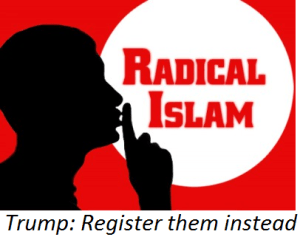 On the heels of a deadly mass shooting in Southern California by a radicalized Muslim couple in December 2015, the then candidate Donald Trump called for “a total and complete shutdown of Muslims entering the United States, until country’s representatives can figure out what is going on.” But what really concerned the Muslims living in the U.S. was Trump’s suggestion to create a database of them, so as to better track suspicious Muslims and detain the radicalized ones before they strike. Now, most of us would agree that the threat of violence by radicalized Muslims in America, regardless of their number, is real—unless one is an ideologue who even refuses to use the term “Radical Islam.” The question is, then, whether restraining Muslim immigration and keeping a registry of Muslims in the states is a useful and just measure.
 A Turkish man sitting next to me in our flight from Istanbul to Antalya in 2015 bore a striking resemblance to Manu Ginobili, an Argentinian basketball player from San Antonio Spurs. When I commented to him of this, he (who spoke some English) became quite pleased after seeing that Ginobili wasn’t bad looking. This then led to a pleasant conversation about religion, including acts of terrorism committed by those who do so in the name of Allah. In one poignant moment, the man said, “Had I seen these terrorists first, I wouldn’t be a Muslim, but I read the Koran first.” I took that to mean, first, the Koran doesn’t advocate violence; and second, the terroristic Muslims do not accurately represent the sacred book.