Editor’s Note: The AMI QT devotionals from May 30th – June 5th are provided by Cami King. Cami, a graduate of the University of Pennsylvania, is about to complete her M.Div. at Gordon- Conwell Theological Seminary. She is currently serving as a staff member at Journey Community Church in Raleigh.
Devotional Thoughts for Today
Galatians 1:18-2:1
Then after three years, I went up to Jerusalem to get acquainted with Cephas and stayed with him fifteen days. 19 I saw none of the other apostles—only James, the Lord’s brother. 20 I assure you before God that what I am writing you is no lie. 21 Then I went to Syria and Cilicia. 22 I was personally unknown to the churches of Judea that are in Christ. 23 They only heard the report: “The man who formerly persecuted us is now preaching the faith he once tried to destroy.” 24 And they praised God because of me. Then after fourteen years, I went up again to Jerusalem, this time with Barnabas. I took Titus along also.
 One of my favorite preachers often says that in all his seminary training, no one ever taught him how to exegete a white space. By that, he means that in all the verses of Scriptures chronicling the lives of our heroes, there are lots of things in the middle: moments between God’s calling and the fulfillment of His promises, between conversion and effective ministry, moments of waiting, heart ache, persecution, confusion, strife that are not written down. They happened in between the recorded moments, and exist somewhere in the white spaces between words on the page.
The timeline of Paul’s life is one of the most well chronicled in Scripture. Although Paul’s point in giving this particular timeline is to assure his readers that the gospel he preached came directly from the Lord, not any human teacher, I love passages like the one above because they remind me that Paul was a real person, walking with God over the span of an actual life time. Oftentimes, in my life, I get bogged down in the day-to-day. My journey with God is full of few moments that feel miraculous and monumental and many that feel fairly mundane and ordinary. Sometimes these in-between moments are merely lackluster, at which point my greatest battle is usually boredom or complacency. Other times they are difficult moments of waiting, heartache, uncertainty, and difficulties when I’m not sure what God is up to or where He is leading me. In those moments, the battles are fierce – doubt, bitterness, unbelief, the temptation to take back the reigns and fail to surrender. It’s in these moments that the skill of white space exegesis is most important – the ability to remember that God is faithful and to trust that He’s still at work.
Are you in an in-between moment today? Are you waiting on God to answer a prayer or come through in a specific situation? Or maybe you are facing another ordinary day of work or school. Don’t despise the seemingly small and insignificant moments (Zechariah 4:10). God is still present and He’s always up to something good.
Prayer: Sovereign Lord, I choose to believe today that You are always with me and to trust that You are constantly at work for my good and for Your glory. Help me to surrender anew today as I put one foot in front of the other and follow You into all You have for me. In Jesus’ name. Amen.
Bible Reading for Today: Psalm 60

Lunch Break Study
Read Colossians 2:6-10: Therefore, just as you received Christ Jesus as Lord, continue to live your lives in him, 7 rooted and built up in him and firm in your faith just as you were taught, and overflowing with thankfulness. 8 Be careful not to allow anyone to captivate you through an empty, deceitful philosophy that is according to human traditions and the elemental spirits of the world, and not according to Christ. 9 For in him all the fullness of deity lives in bodily form, 10 and you have been filled in him, who is the head over every ruler and authority.
Questions to Consider:
- According to the passage, how can we “live lives in him”?
- Are there any popular teachings and philosophies threatening to captivate you today? How do they align with the truth of God’s Word?
- Paul reminds his readers of the lordship and authority of Christ. Why is this important?
Notes:
- We can “live lives in him” in three ways”: (1) by being rooted and built up in him, (2) by standing firm in our faith, and (3) by overflowing with thanksgiving. Foundational to all three of these is receiving Jesus as Lord – surrendering our lives to Him and following His leadership.
- Paul is condemning false teachers who are propagating “additions to Christ” and leading the believers astray with teaching based on tradition and worldly practices. There are many popular teachings and philosophies in our culture today. What, if any, are based more on tradition and worldly practices than on the truth of God’s word? Some areas to consider: philosophies regarding work place ethics, finances, marriage, dating, child rearing, success and achievement, etc.
- When we remember that Jesus is Lord, we yield to His word over every other teaching around us. It serves as the standard against which we evaluate everything else. This gives us a firm foundation that is not so easily shaken by the popular teachings and philosophies of our day.
Evening Reflection
Spend some time reflecting on an in-between season in your life. What challenges did you face? How did you experience God’s faithfulness? Ask the Lord to encourage you through your past experiences with Him, and to continue to follow Him faithfully in the future.
 Editor’s Note: The AMI QT devotionals from May 30th – June 5th are provided by Cami King. Cami, a graduate of the University of Pennsylvania, is about to complete her M.Div. at Gordon- Conwell Theological Seminary. She is currently serving as a staff member at Journey Community Church in Raleigh.
  “When one of my friends becomes a Christian, which happens about every 10 years because I am a sheep about sharing my faith, the experience is euphoric. I see in their eyes the trueness of the story.” (Donald Miller, Blue Like Jazz: Nonreligious Thoughts on Christian Spirituality)
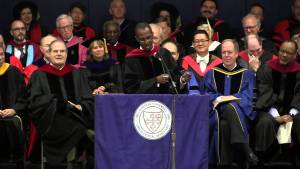 A few weeks ago, I attended my seminary’s graduation and heard two speakers for the weekend – a professor of business ethics for Baccalaureate and a well-known local pastor for Commencement. They were two very different speeches from two very different perspectives, but both centered around reflections in light of the changing culture and uneasy social and political climate in America. For those who know me well, it’s no secret that I am a self-proclaimed sermon junkie. As I listen to my usual line-up these days, preachers from around the country, from various denominational, theological, socio-economic backgrounds, continue to address how the church should respond to current political and social realities. This has been a question for me personally as well – what should be my response as a Christian to the slew of partisan issues and hot-button topics abuzz in the media, on university campuses, and around dining room tables alike?
 Paul spends a lot of time in the beginning of this letter legitimizing his gospel message and the authority with which He preaches it. Apparently, that authority was being questioned by those influencing his readers, and Paul wanted to set the record straight – that his message and authority are from God alone. Although none of us has quite the same mission as Paul, as we are not Apostles, we are all on mission for the Lord. Wherever we are and in all that we do, we have been led by God to that place and been given Good News to share with those around us.
 The Medal of Honor is the highest military decoration one can receive in the US, awarded directly by the President himself. It is for those who have shown the greatest bravery in a time of great need. An example of this is Master Sergeant Roy Benavidez, who risked his life to save 12 men by boldly stepping into enemy infested territory. One survivor highlights how Benavidez was shot over 20 times, suffered a grenade explosion, and yet crawled to his men to give out water and ammunition. When I think of the words “bold” and “courage,” he is certainly someone that embodies them, and in many ways, these words also reflect the life that Apostle Paul lived for the gospel. In fact, today’s passage is an accurate mission statement of Paul’s life.
 One of the greatest privileges I’ve had in my Christian journey was to share the gospel with a friend. The conversation initially started philosophically, centering on the evil of mankind. We explored some of the worst events in history along with those happening today and found no hope for mankind. I don’t know how or why, but we changed topics to the Bible—thank You, Jesus! I conjured up as many Bible stories a churched kid could remember, starting from the Gospels, sharing the accounts of Jesus and the manner in which He loved people. He was in utter disbelief and his only response was, “Tell me more. Tell me more about this Jesus.” These were the same stories that I heard repeatedly growing up, yet his reaction amazed me—it was as if he found a new treasure. He expressed great interest in the person of Jesus, his culture, and how Jesus talked to certain people—everything. If only every member in church could listen as attentively as my friend did, the church would have revival! It was then I realized just how dull my heart had become to God’s truth.
 A while ago, I had the privilege of meeting a member of one of most notorious gangs in the US. At the age of 12, he walked the streets with his first assignment to shoot a rival member in order to prove his loyalty. His reason for joining was that it gave him a sense of purpose, belongingness, and value. He spent the next five years wasting his life, resulting in unforgettable memories that he now trembles at when recalling such experiences. By the end of those years, he was caught and said that at the time, it was the greatest disappointment for him and his gang, yet later, he realized it was the greatest appointment by a Savior who was calling him. What was ironic for him was that he began to learn what hope really meant behind bars in a dark, hopeless prison cell.
 Cut loose the lifeboat. Imagine us being the men on the boat. We barely survived a storm and as we’re finally approaching land, the “godly man” says to stay on the boat. The crazier part is to see my fellow soldiers listening to Paul and cutting our only lifeboat and letting it go. At this point, I would’ve jumped off the boat and swam after the lifeboat. What got into the minds of these soldiers to do something so radical? Some might call it crazy, but I would call it faith.
 Whenever I complained about school, my parents always told me the most extravagant stories: “When I was young I had to climb mountains, walk 5 miles each way, and hunt for my lunch just to go to school.” It was the go-to motivational speech in the Kim household, with the same message: “You have it good, so no complaints.” By no means do I undermine my parent’s past, because I fully acknowledge that I am blessed today because of their sufferings. Maybe some of us do not share the same story, but we can all agree that the life we live today is possible because someone in the past has paved the way. Even Isaac Newton acknowledges that all the things he had accomplished were made feasible by “standing upon the shoulders of giants.”
 Editor’s Note: The AMI QT Devotionals from May 23-29 are written by Andy Kim. Andy, a graduate of Northwestern University, is about to complete his M.Div. at Fuller Theological Seminary. He is currently serving as a staff at Radiance Christian Church in San Francisco, CA
 Car accidents scare me—especially ones that involve rain. My friend describes it as the most helpless moment in his life: He turned the wheel left and right, but the car refused to listen. After hitting a dry patch, the car flipped and rolled on a busy highway. Here’s the kicker: he came out with a small scratch on his head, while the car was completely totaled. In fact, the people that were behind him were a doctor and nurse –they stood watching in shock. Praise the Lord!