 The AMI QT Devotionals from February 2-3 are provided by Pastor Mark Chun of Radiance Christian Church in S. F. Mark, a graduate of University of California, San Diego, and Talbot School of Theology (M.Div.), has been married to Mira for 20 years; they have two children, Jeremiah and Carissa.
Disclaimer: The views expressed here do not necessarily represent the respective views of AMI pastors.
DEVOTIONAL THOUGHT FOR TODAY
An Inconvenient Truth about Abortion (1)*
2 Kings 16: 1-6 (NIV)
In the seventeenth year of Pekah son of Remaliah, Ahaz son of Jotham king of Judah began to reign. 2 Ahaz was twenty years old when he became king, and he reigned in Jerusalem sixteen years. Unlike David his father, he did not do what was right in the eyes of the Lord his God. 3 He followed the ways of the kings of Israel and even sacrificed his son in the fire, engaging in the detestable practices of the nations the Lord had driven out before the Israelites. 4 He offered sacrifices and burned incense at the high places, on the hilltops and under every spreading tree. 5 Then Rezin king of Aram and Pekah son of Remaliah king of Israel marched up to fight against Jerusalem and besieged Ahaz, but they could not overpower him. 6 At that time, Rezin king of Aram recovered Elath for Aram by driving out the people of Judah. Edomites then moved into Elath and have lived there to this day.
 While I squirmed over having to present a morning devotional based on a passage dealing with infanticide, we, as followers of a holy God, need to deal with the horrifying nature of sin head on.
In reading about the reign of King Ahaz, I think most of us would agree with the biblical assessment that this man did evil in the eyes of the Lord. Faced with the threat of being conquered by his political enemies, Ahaz committed the unthinkable act of sacrificing his son to pagan idols in the hope that they would deliver him from this situation. His desire to maintain power and control overrode any remnant of moral conscience that this man may have had and became his excuse to commit the inexcusable sin of sacrificing his child. And it appears that Ahaz’s idols gave him exactly what he desired: he withstood the attack of the armies of Aram and Israel. However, in the annals of biblical history, this was a victory that felt more like a defeat.
In 1973, there was another victory that seemed rather hollow, because it, too, involved the sacrifice of children: the landmark Supreme Court case known as Roe v. Wade. Ironically, some who oppose infanticide do an about-face over feticide, which actually is infanticide unless the humanness of the one in the womb, whether 12 or 32 weeks old, is categorically denied.
This morning, I want to be sensitive to those women who have endured the shame of abortion and offer the forgiveness and healing of Christ. Yet, at the same time, I would like to shed light on this issue. The advocates for on-demand legalized abortion celebrated the decision as a victory for all women, but they forgot to mention the countless children lost as a result of the verdict. And since that decision in 1973, over 50 million abortions have been performed in the United States. Planned Parenthood, an organization that performs most of these abortions, plainly states that one of out of three babies conceived in the United States is deliberately aborted. Over 1 million abortions will be reported in this country this year alone. These aren’t just numbers but real people who could have been our brothers or sisters, brilliant scientists or outstanding theologians.
Maybe you have had an abortion? Confess that sin to Christ and receive His forgiveness and healing. There is no sin that God won’t or can’t forgive.
Prayer
Lord, Your word tells us that You have known us from the very moment we were conceived, and that we were wonderfully and fearfully formed in our mother’s womb. Help us to understand the sanctity of life and the awesome privilege of having children who bear Your image. May You protect our marriages, our families, and especially our children as we live against the tides of this culture. Amen.
Bible Reading for Today: Judges 11
*Today and tomorrow’s AMI QT Devotionals are reprints from 2014.
LUNCH BREAK STUDY
Matthew 19:13-15 (NIV)
13 Then people brought little children to Jesus for him to place his hands on them and pray for them. But the disciples rebuked them. 14 Jesus said, “Let the little children come to me, and do not hinder them, for the kingdom of heaven belongs to such as these.” 15 When he had placed his hands on them, he went on from there. [1]
Questions to Consider:
- Why did the disciples rebuke people for bringing their children to be blessed by Jesus?
- What is Jesus’ attitude towards the children?
- What does it mean that the kingdom of heaven belongs to children?
Notes
- Ancient cultures held children in low-esteem and did not see it worthwhile to go out of their way for them. In addition, the disciples were intent on getting to the next place of ministry and saw this interruption as a hindrance.
- Jesus’ attitude is completely opposite of the disciples. He gladly takes the time to lay hands and to pray for each child. As believers, we should treat all children with the same attitude that Jesus did—as special recipients of God’s love, even prior to their personal commitment to Christ.
- Childlike dependence and innocent faith are the hallmarks of an authentic relationship with our heavenly Father. Although there may be room for doubt, cynicism, and a critical heart, these things can easily poison our walk with God. What this verse does not mean is that all children go to heaven.
[1] The New International Version. (2011). (Mt 19:13–15). Grand Rapids, MI: Zondervan.
EVENING REFLECTION
I recently read a post from a person, who I thought was a committed follower of Christ, stating that he was indifferent to the subject of abortion. This deeply saddened me because I don’t believe this espouses the heart of God. Although we don’t want to make hot button topics bigger than they are in relation to the Gospel of Christ, at the same time, we must hold unwavering to a Christian worldview and ethic. It is important that we think through our position on many cultural and societal matters and hold fast to the Scriptures as our guide. Take time tonight to ask the Lord to give you clarity on the controversial issues that Christians face and the courage to stand for the truth.
 When “Jorge”—originally from Puerto Rico—saw me jogging in Chester Park this December, he was happy to see me, since we hadn’t seen each other for over three years—I had moved away from that neighborhood. As we were chatting, my ears perked up when Jorge, a naturalized citizen who has long retired, said that he voted for Trump, since only a quarter of Hispanics voted for Trump. Seeing my surprised reaction, he added, “I was going to vote for Clinton, until the third debate made me realize that her position could make any abortion legal at any point during a pregnancy.” Then it dawned on me that most foreign-born Hispanics (i.e., immigrants), certainly more religious than the general population, are socially more conservative. About 60 percent of them (PEW Research Center 2014), perhaps still bearing the influence of Catholicism, continue to hold that what’s inside the womb is life.
 One can be tempted to think that justice is synonymous with “social justice,” that it is all about maintaining fair social and political relations. But in Christianity, the primary aspect of justice is about how the individual relates to God; the word “justification,” which is at the heart of salvation, is just another form of the Greek word for “justice.” Christian justice is mainly about how a person can be made right before God, which is through faith in divine grace and exemplified by good works.
 In our world, there seems to be a new name above all names, the purpose above all purposes—the almighty ideal of social justice. It would be troublesome, however, if social justice is viewed in the same light as the saying, “One man’s art is another man’s pornography.” Yet there have been many different conceptions of justice throughout the ages. Thrasymachus in Plato’s Republic says that justice is simply whatever the strongest in society have deemed to be just (“Might makes right”). The 18th century philosopher David Hume said that justice is a human convention invented for the collective self-interest. Popular, contemporary theories of social justice revolve around ending the oppression of identity-categorized minorities based on race, gender, and sexuality.
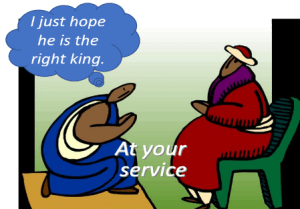 Somebody is terribly mistaken here! As Isaiah 1:17 indicates, a desire for justice is good, but if predicated on a reckless theory of justice, such passion can be a great force for injustice. We can have all the fervor of a patriotic warrior as we march off to the grand, glorious war for social justice, but if we have pledged allegiance to the wrong ideological king, we may find ourselves making the nations much worse off. An earnest search for wisdom, knowledge, and God’s justice can go a long way toward making sure our social justice arrows hit the right targets.
 The AMI QT Devotionals for January 28-29 are provided by Joanna Tzen. Joanna graduated from U. Penn and currently works in Philadelphia. She married Paul in 2014, and they attend Grace Covenant Church.
 Yesterday, we talked about Sabbath, but maybe there is the question of whether this is even necessary, practical, or applicable in today’s world. I know that in my own life, there were instances where I misinterpreted the need for Sabbath as a weakness. Clearly, I was equating my worth to my productivity. So if I saw a need or an opportunity was presented, I quickly accepted. Though some good still came out of those decisions, it often came at the greater expense of my relationship with God or others, or other priorities to which I was committed.
 I’ve been reading a book titled Emotionally Healthy Leader, where the author interestingly brings up the topic of the Sabbath. So what exactly is a Sabbath? Is it an Old Testament practice that we no longer observe as Christians?
 The recent United Nations Security Council’s resolution to condemn Israeli settlement in territories taken during the Six-Day War (1967) continues to stir passion on both sides. While U.S. support for Israel may not be what it used to be, Christians who believe in the literal fulfillment of end-time prophecies are squarely on the side of Israel. Yet, in the midst of this bitter conflict, we have forgotten a people whom the believers have more in common with than the Israelis.
 In 2015, while attending a conference on theological education in Turkey, I befriended a theological educator named Jiries from Jordan. He is a Palestinian. Never having met a Palestinian Christian before, I cautiously asked, “How do you feel about American Christians unilaterally supporting Israel?” Jiries answered, “It’s a matter of human interpretation of the Bible on the one hand, and God’s justice on the other.” I understood what he meant by “human interpretation,” but since I didn’t get the justice part, I asked for an explanation. The following is his story.
 Last March, no one was in a small Narita airport chapel when I entered; later, while I was reading the Bible, a young Muslim walked in. I quickly felt uncomfortable because he prayed in a prostrated position directly in front of me. Upon seeing the ceiling compass, however, I realized that I sat in a direction toward Mecca. While the scene may have looked funny to some, no distraction was going to keep this Muslim from prostrating before Allah—that’s taking one’s faith seriously and we ought to respect that!
 Shortly thereafter, a Muslim woman walked in; and before praying, she first put on her white prayer clothe. But when I glanced to see if she was praying, to my humor, I saw her fidgeting with her smartphone. I had no idea what she was searching, but seeing her sidetracked by the same gadget that distracts all of us had a strange effect of identifying with her humanity—that is, whether we are Christians and Muslims, we, as human beings, share a lot in common.
 But to say that Christians and Muslims pray to the same God would be an insult to both. I tried to demonstrate that the first time I visited a prayer room at the Hong Kong airport. Seeing that only Muslims were praying, I also wanted them to know that Christians pray earnestly and take prayer seriously just as much as Muslims do, since they typically believe that Christians don’t really pray much. First, to distinguish myself as a Christian, I knelt facing the opposite direction from the wall faced by Muslims. At the outset, I was very conscious of wanting to show an earnest praying Christian, but as my prayer got more intense, I forgot all about my surroundings. It dawned on me only after I was done praying that I was the only one left in the chapel. To the extent that any Muslims in the chapel noticed a Christian praying as fervently and extendedly as they, I hope it was a moment of distinguishing our faith. That day, nothing really happened in the prayer room: They prayed, and I did too, with no one interfering on another.
 A Christian apologist writes, “Christianity is the only true faith, all other religions are of the Devil. . . .”
 What’s substantially different among them is their afterlife strategy: Buddhism exhorts its followers to do good on earth to achieve a better reincarnation, while Islam demands that its adherents obey the Five Pillars of Faith (the confession, daily prayers, almsgiving, fast, pilgrimage to Mecca). In short, these are man’s effort to save himself. On the contrary, the Christian faith declares that since man cannot save himself because of sin, God saves him through the atoning death of His Son Jesus. In short, this is God’s effort to save man. On this account, we break with Eisenhower: Our salvation makes no sense unless it is founded on the belief in Jesus Christ.
 After reading a story about Christian mission work in a Muslim country, a reader commented, “Since when did we consider the Muslims to be unbelievers? They do not need to be converted because the Christians and Muslims believe and worship the same God.” This person’s point isn’t entirely without merit, since both the Syrian Christians and Jews referred to God as Allah before the rise of Mohammed in the 6th century. But upon a closer examination, because the original meaning attached to the name Allah underwent a dramatic makeover in the Koran, anyone who says that the Christians and Muslims worship the same God is either ignorant or condescending toward religion itself.