January 23, Monday

Pastor Ryun Chang (AMI Teaching Pastor, Ph.D.) will present a series of blogs, dealing with various issues raised in the recent election that showed a deep divide, impacting both society at large and the church.  The thoughts presented are processed through the lens of the Radical-Middle (both/and), personal narratives, and pastoral concerns.  Your rational feedback is welcomed.

Disclaimer: The views expressed here do not necessarily represent the respective views of AMI pastors.

DEVOTIONAL THOUGHT FOR TODAY

How 9/11 Changed My Outlook on Islam

Col. 4:5: Conduct yourselves with wisdom toward outsiders, making the most of the opportunity.

Jn. 1:1: In the beginning was the Word, and the Word was with God, and the Word (Jesus) was God.

23As Bible-believing Christians, we ought to disagree with contrary beliefs, but if we are to love our “enemies” (i.e., those with whom we disagree), we should make some effort to know what they actually teach, and then disagree—rather than going just by secondary sources, or worse, hearsays.  So when I started to study about Islam, I discovered—to my surprise— some agreeable things the Koran says about Christ.

The 9/11 occurred less than two weeks after we moved to Chihuahua, Mexico, a city about 250 miles south of El Paso, Texas.  After this happened, I knew I had to get a copy of the Koran.  It so happened that my family and I already had plane tickets to visit my father in Philadelphia for his 70th birthday bash at the end of October.  Crossing the line at the border, which took forever because of extra security measures, was another reminder that as a missionary who taught, among other subjects, missiology, it was imperative that I understood Islam.  After scouring several bookstores in Philly, I was disappointed to find only a copy that contained excerpts from the Koran; later, when Florida pastor Terry Jones threatened to burn  the Korans, I was screaming, “Give a copy to me!”

After eventually securing a Koran and reading it—along with several books on Islam—I discovered that while Islam considers Mohammed as the highest ranking of all the prophets, including Jesus, it actually seems to present Jesus as more than just a prophet—maybe even “better” than Mohammed.  For instance, while the Koran presents Jesus as a worker of miracles (raising the dead and healing the lepers), no miracle is attributed to Muhammad (29:49b: “My mission is only to give plain warning”).

While Jesus is said to be without blemish, Muhammad is told to seek forgiveness for his sins (40:55b: “Allah´s promise is true.  Implore Him to forgive your sins”).  The Koran even says of Jesus, in semblance to John 1:1, “a Word from Him whose name is Messiah, Jesus, son of Mary; high honored shall he be in this world and the next, near stationed to God” (3:40).

Of course, there are several substantially conflicting teachings about Christ in the Koran that can hardly be bridged with the Bible.  What I discovered from the Koran, however, is sufficient to “conduct [myself] with wisdom toward outsiders (like Muslims), making the most of the opportunity” (Col. 4:5) by, first, presenting myself as a curious inquisitor.

My advice to you: Islam, with its 1.7 billion adherents, isn’t going away; therefore, get to know Islam and the Koran.  Know the key differences so as to realize that Christians and Muslims do not worship the same God (discussed tomorrow); utilize any similarities between the two to begin dialoguing with them.

Prayer: Lord, the presence of many religions in the world is quite daunting to our faith, since we believe that salvation is found only in Jesus.  Help me, Father, to understand and appreciate world religions; impart to me the necessary knowledge and wisdom to speak to them about our Savior Christ.  Amen.

Bible Reading for Today: 2 Kings 25


LUNCH BREAK STUDY

Read John 20:31: But these are written so that you may believe that Jesus is the Christ, the Son of God, and that by believing you may have life in his name.

1 Jn. 2:23: No one who denies the Son has the Father; whoever acknowledges the Son has the Father also.

The Koran declares, “Say: Allah is One, the Eternal God.  He begot none, nor was He begotten. None is equal to Him” (112); “Allah forbid that He should have a son. . ..”  (4:171).

Questions to Consider

  1. What is a key difference between the Bible and Koran over the Sonship of Christ?
  2. Is that difference trivial or essential? Can we consider those who deny the Sonship of Christ as having the Father?
  3. John 3:36 (NIV) says: “Whoever believes in the Son has eternal life, but whoever rejects the Son will not see life, for God’s wrath remains on him.” Can you make a theological sense of this passage?

Note

  1. Whereas the Sonship of Christ (but not in a physical sense) is crucial to the centrality of the Christian faith, Islam denies that God (Allah) has a son.
  2. This is an essential difference, because Scripture declares that those who deny the Son do not have the Father—meaning, believing in God without believing in the Son is not part of the New Testament faith, that is, a saving faith.
  3. The wrath of a holy God toward sinners is the default position, and it is the substitutionary death of the Son that perfectly satisfied this wrath. Thus, it stands to reason that if one rejects the Son and his atoning work, then, God’s wrath will continue to remain on him.

EVENING REFLECTION

Where were you when 9/11 occurred?  How did it change your world?  Well, if you are like the rest, the change didn’t last too long, unless you were directly victimized by the terror.  One thing that will never change is that the Son died on the cross to “take away the sin of the world” (Jn. 1:29).  In contrast, the Koran says: “[The Jews] said, ‘We killed the Messiah, Jesus Son of Mary, the messenger of Allah,’ but they killed him not nor crucified him but it seemed so to them. . .. But Allah took him up to himself.”[1]  Ultimately, Muslims need to be convinced that Jesus died for their sins.  Would you pray right now for missionaries serving in Islamic countries that they would clearly, boldly, and lovingly share the good news of Jesus Christ?  Pray that you would be equipped to speak cogently to a Muslim neighbor about Christ.

[1] However, Koran 5:17 appears to say that Jesus did die: “Say, who could prevent Allah from destroying the Messiah, the Son of Mary, together with his mother and all the people of the earth?

January 22, Sunday

The AMI QT devotionals for January 21-2 are provided by Christine Li.  Christine graduated from University of Pennsylvania and currently lives and works in New York City.  She attends Remnant Church in Manhattan.
christineli

P. Ryun’s series will continue on Monday.

DEVOTIONAL THOUGHT FOR TODAY

Friendship with God

John 15:15:

“I no longer call you servants, because a servant does not know his master’s business. Instead, I have called you friends, for everything that I learned from my Father I have made known to you.”

22There was a time in elementary school when my classmates and I would feel insecure about our friendships. The only way to definitively confirm whether we were friends with someone was by way of a note with checkboxes for “Yes” or “No” and the question, “Dear so-and-so, are you my friend?” Once we were assured of our friend status, we could begin freely sharing our lives – snacks, jokes, toys, secrets, etc. – and trust that our friends would reciprocate.

I would say that grown-up friendships are not so different. They start out a little uncertain, but once we confirm that we’ve passed a threshold from “acquaintances” to “friends,” we begin to open our lives to each other. Our conversations become more frequent and more comfortable. We begin to tell them all our thoughts and ideas, and we begin to care about and remember things that others share with us – their likes, dislikes, schedules, funny habits, goals, dreams, etc.

When Christ walked on earth, He not only taught us about the new, righteous lives we could have through Him, but He also redefined our relationships with God. Though He already revealed Himself to be God Almighty, He left his disciples with a new status. They were not servants, but friends. God had shared His life, His thoughts, His habits, and His will with them. He had walked with them and was their constant companion.

What the disciples received is for us as well. To call ourselves friends of God might sound overly audacious and bold, but it is a relationship He has invited us into. So, why don’t we take advantage of the opportunity to take Him at His word?

Today, as we enter the house of God, let’s approach Him with the same expectation and familiarity of being with a friend. We can be assured that we belong in His presence and that we can ask for His attention to listen to our troubles and joys. As our relationship with God grows, we will surely find that it is a two-way street – the more we draw near and become closer to Him, the more He will also reveal Himself to us, too.

Prayer: Lord, thank You that You have first loved us and chosen us to be with You. Thank You for the privilege to know You as a friend and to be intimate with You. Help us to freely come to You so that we can walk in step with You and know You better. Teach us to listen to You and to become more attuned to Your guidance and will.  Amen.

Bible Reading for Today: 2 Kings 24

January 21, Saturday

christineliThe AMI QT devotionals for January 21-2 are provided by Christine Li.  Christine graduated from University of Pennsylvania and currently lives and works in New York City.  She attends Remnant Church in Manhattan.

P. Ryun’s series will continue on Monday.

DEVOTIONAL THOUGHT FOR TODAY

Cleaning the Lenses of Our Hearts

1 Corinthians 13:4-5

Love is patient, love is kind. It does not envy, it does not boast, it is not proud. It does not dishonor others, it is not self-seeking, it is not easily angered, it keeps no record of wrongs

John 13:35

A new commandment I give you: Love one another. As I have loved you, so also you must love one another. By this all men will know that you are My disciples, if you love one another.

21Every so often, I need to be reminded to clean my glasses. I frequently forget to do this, because it seems unnecessary— my glasses don’t look dirty. However, every time I wipe down the lenses, seeing becomes a whole new experience. I realize that over time, the small and steady accumulation of dust and dirt slowly built up and made everything unclear.

Imagine if I never cleaned my glasses but allowed dirt, dust, mud, splashes of food, etc., to cake onto my glasses. Not only would this be incredibly unhygienic, but I’d also never be able to see anything properly. There would always be something obstructing my line of vision, or everything would be colored wrongly.

This is the kind of consequence I imagine for when we are unloving – particularly when we keep records of wrongs for each other. If we do not keep our lenses clean, so to speak, when we look at the people around us, we will be clouded by residue from unhappy reminders of the past: unkind words, disappointments, hurt feelings, etc. Because our registry of people is tinged with something negative, our desire to love each other will also be hindered.

One of Jesus’s commands is for us to love each other in a supernatural way. Let’s consider whether we truly apply ourselves to this work. Do others know that we are Christ’s disciples because we merely profess to be so, or are we distinguished by the way we treat others around us? Is there something special about the way we forgive, restore, and serve others? Do we perceive others as blameless and beloved sons and daughters of God, or do we use our grievances to paint a different opinion of them?

I am not suggesting that forgiveness and reconciliation are simple tasks. But thankfully, we know that they are not impossible, for we have a God who has succeeded in modeling this love for us. Through His sacrifice, He equips us each day to do the same. In 2017, may our churches seek to be filled with the kind of loving witness that God desires us to have. Let’s keep asking Him to fill us with His power to refresh our hearts and eyes for one another.

Prayer: Father, thank You for the love You have demonstrated for us. Teach us to be people who truly love with Your love. Won’t You remind us that we are new creations along with our brothers and sisters each day? Give us eyes to see what You see in others, and please equip us to love one another, not with the capacity of our hearts, but with Yours.

Bible Reading for Today: 2 Kings 22-23

January 20, Friday

Pastor Ryun Chang (AMI Teaching Pastor, Ph.D.) will present a series of blogs, dealing with various issues raised in the recent election that showed a deep divide, impacting both society at large and the church.  The thoughts presented are processed through the lens of the Radical-Middle (both/and), personal narratives, and pastoral concerns.  Your rational feedback is welcomed.

Disclaimer: The views expressed here do not necessarily represent the respective views of AMI pastors.

DEVOTIONAL THOUGHT FOR TODAY

Are You Keeping Scores?  It’s a Tie “Ballgame.”

Mathew 5:43-4

“You have heard that it was said, ‘Love your neighbor and hate your enemy.’ 44 But I tell you, love your enemies and pray for those who persecute you.”

20On the web, I found this statement: “Christians have invaded and colonized a dozen Muslim countries in the past 100 years.”  My response: Why start the discussion from such an arbitrary point; why not begin from the very outset of their clash at the geopolitical level?  Those who want to lay all the blame on the church may not want to go there, because it will not fit their revisionist and selective history.

The first clash between these two groups occurred in the 8th century, when the Moors from North Africa, who had been conquered and converted to Islam by the Saracen Empire (from Middle East), successfully attacked Spain.  They then penetrated as far as central France (Tours) to subject the entire Europe to Islam.

The next major clash was the infamous Crusades, beginning from 1095, for which the Roman Catholic Church owes a major apology to the Muslims, Jews and believers of the Eastern Church, since they all fell victims to these misguided and radicalized Christians from Europe.   If you are keeping scores, it is 1:1.

Now, here is how I became aware of the third clash.  In 1992, after Bosnia—as part of former Yugoslavia—declared its independence, the Serbs began the campaign to “cleanse” much of the Bosnian territory contiguous with Serbia.  Subsequently, as many as 2 million Bosnians (about 44% being Muslims) were displaced out of Bosnia.  While reading about this, I began wondering how these Eastern Europeans became Muslims in the first place.  It was because after the Ottoman Turks conquered the Serbs (including Bosnia in 1463) as part of their military campaign against the Holy Roman Empire, the Turks forced the conversions of the Bosnian nobility, which one author described as “unusually harsh.”  Over the years, while one group of Serbs became Muslims, the rest continued to be part of the Orthodox Church.

The 4th round of their conflict occurred when European countries such as England and France occupied Iraq and Syria, respectively, at the behest of the League of Nations after World War I.  This event and the Crusades, then, are selectively cited by the critics of the church to present Christianity in its worst light.

Presently, the 5th round of their ongoing conflict (including the 9/11 and the military response thereafter by America) is played out on the soils of Europe and America through terrorism carried out by radicalized Muslims.

No, don’t keep scores—that’s foolishness.  Instead, since we claim to follow Christ who taught us to “love your enemies,” let us love Muslims, most of whom are our neighbors, not enemies.

Prayer: Lord, help me open my spiritual and theological eyes to understand that Your common grace is given to all, including Muslims.  Give me humility and soundness of mind not to paint all Muslims with a broad brush based on terroristic acts committed by radicalized Muslims.  Give me courage to love them. Amen.

Bible Reading for Today: 2 Kings 21


LUNCH BREAK STUDY

20bRead Jonah 1:1-3 (NIV): The word of the Lord came to Jonah son of Amittai: 2 “Go to the great city of Nineveh and preach against it, because its wickedness has come up before me.”3 But Jonah ran away from the Lord and headed for Tarshish. He went down to Joppa, where he found a ship bound for that port. After paying the fare, he went aboard and sailed for Tarshish to flee from the Lord
Questions to Consider

  1. Based on the prior (before the time of Jonah around 760 B.C.) and on-going conflict between Israel and Assyria (known for their cruelty), can you understand why Jonah did not want to preach in Nineveh?
  2. What is one similarity between how Jonah felt toward the Assyrians and how some Christians in the West feel toward radicalized Muslims and their sympathizers?
  3. The Assyrians worshipped many gods, including Tammuz (Ez. 8:14). What is suggested by God’s call to Jonah to preach the message of repentance in Nineveh (the capital of the Assyrian Empire)?  How should that realization change us?

Notes

  1. Yes, we can sympathize with Jonah. Understandably, Jonah wanted to see the Assyrians pay for their ruthlessness and cruelty meted out against his people.
  2. The similarity is obvious: inasmuch as Jonah disliked the Assyrians, some Christians in the West dislike the Muslims because of terroristic acts committed by some radicalized Muslims.
  3. It shows clearly the heart of God for all nations, which is aptly summarized by the apostle Peter: “The Lord is not slow in keeping his promise, as some understand slowness. Instead, he is patient with you, not wanting anyone to perish, but everyone to come to repentance” (2 Pet. 3:9). We should all be dedicated to world missions, which, at its center, is bringing the gospel to the nations.

EVENING REFLECTION

When was the last time you read a book that deals with church history?  What was presented in the morning devotional came from the study of church history.  We must know it because the enemy is using revisionist history to debunk our faith (e.g., The Da Vinci Code).  Try Church History in Plain Language by Bruce Shelley (Thomas Nelson 2013).  Also, familiarize yourself with the kings of Israel by reading 1 & 2 Samuel; 1 & 2 Kings; and 1 & 2 Chronicles.

January 19, Thursday

Pastor Ryun Chang (AMI Teaching Pastor, Ph.D.) will present a series of blogs, dealing with various issues raised in the recent election that showed a deep divide, impacting both society at large and the church.  The thoughts presented are processed through the lens of the Radical-Middle (both/and), personal narratives, and pastoral concerns.  Your rational feedback is welcomed.

Disclaimer: The views expressed here do not necessarily represent the respective views of AMI pastors.

DEVOTIONAL THOUGHT FOR TODAY

To Register or Not Register Muslims

Esther 3:8-11 (NIV)

Haman said to King Ahasuerus, “There is a certain people scattered and dispersed among the peoples in all the provinces of your kingdom; their laws are different from those of all other people and they do not observe the king’s laws, so it is not in the king’s interest to let them remain. 9 If it is pleasing to the king, let it be decreed that they be destroyed, and I will pay ten thousand talents of silver into the hands of those who carry on the king’s business, to put into the king’s treasuries.” 10 Then the king took his signet ring from his hand and gave it to Haman, the son of Hammedatha the Agagite, the enemy of the Jews. 11 The king said to Haman, “The silver is yours, and the people also, to do with them as you please.”

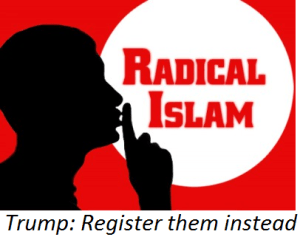
19On the heels of a deadly mass shooting in Southern California by a radicalized Muslim couple in December 2015, the then candidate Donald Trump called for “a total and complete shutdown of Muslims entering the United States, until country’s representatives can figure out what is going on.”  But what really concerned the Muslims living in the U.S. was Trump’s suggestion to create a database of them, so as to better track suspicious Muslims and detain the radicalized ones before they strike.   Now, most of us would agree that the threat of violence by radicalized Muslims in America, regardless of their number, is real—unless one is an ideologue who even refuses to use the term “Radical Islam.” The question is, then, whether restraining Muslim immigration and keeping a registry of Muslims in the states is a useful and just measure.

While there isn’t any comparable situation in the Scriptures, the above passage can shed some light on the matter.  Haman, a highly-ranked official in Persian Empire, who belonged to the Amalekites (1 Sam. 15:1-9), an archenemy of Israel (Deut. 25:17-9), plotted to single out the Jews and then exterminate them.   While no sane person would dare to equate this situation with ours, one similarity needs to be noted: singling out one group from the larger society because of one’s ethnicity or religion.  Historically, that sort of distinction—such as Hitler singling out the Jews in Germany and Franklin Roosevelt singling out the Japanese in America—has not ended well.

At the same time, since American citizens have consented to relinquishing some of their freedom and submitting to the governing authority in exchange for protection, they are within their rights to expect the government to stop playing with words and do something substantial to reduce the possibility of terror.  So what does that mean?  First, the citizens have the right to expect the government to improve the vetting process to keep the radicalized Muslims from entering the American soil, but without restraining Muslim immigration itself.  Any extra measures taken to ensure this outcome may slow down the immigration process in general, but that is par for the course.   Second, while preventing every act of terrorism by radicalized Muslims is an impossible task, perhaps, what travelers are told to do in airports can be extended to the society at large: “If you see something, say something.”  Perhaps a hotline can be established to make it easier to report those who make terroristic threats in the name of Allah, after which, the allegations can be vigorously and fairly pursued by the respective agencies.

Meanwhile, we pray for a safer America for all law-abiding citizens—which certainly include Muslims (except for a few radicalized ones) whom God of the Bible cares for (Acts 14:17) and loves (Jn. 3:16).

Prayer: Father, we pray for a safer America where people of all races, ethnicities and religions can live peacefully.  While we lift up those of the Islamic faith in America so that none of them would attacked or insulted by misguided individuals, we pray against the Radicalized Islam and its acts of terrorism.  Amen.

Bible Reading for Today: 2 Kings 18


LUNCH BREAK STUDY

Read Romans 12:16-8: Live in harmony with one another. Do not be proud, but be willing to associate with people of low position. Do not be conceited. 17 Do not repay anyone evil for evil. Be careful to do what is right in the eyes of everyone. 18 If it is possible, as far as it depends on you, live at peace with everyone.

Questions to Consider

  1. Which part of this passage is more relevant to embodying the kind of commitment that the Christians must have in order to love those of other faiths?
  2. What attitude or perspective is needed for non-Muslim Americans in order to live at peace with the Muslims in America?
  3. What attitude or measure is needed for Muslims in America in order to live at peace with those who are not Muslims in America?

Notes

  1. I think “live in harmony with one another” and “as far as it depends on you, live at peace with everyone” are more relevant to embodying the kind of commitment that we need in order to love those of other faith.
  2. One necessary attitude/perspective is to see that the predominant majority of Muslims in America are peaceful and decent people, who care about the welfare of the American society.
  3. One necessary attitude/measure is to condemn, unequivocally and swiftly, any acts of terrorism committed by Radicalized Muslims, whether home or abroad.

EVENING REFLECTION

Looking back to your day, did you see or talk to a person of Islamic faith at school or office?  Offer an earnest prayer on his or her behalf—pray for that person so he/she would experience the fullest measure of God’s common grace.  Pray that that person would one day realize that Jesus is not just a prophet but the Son of God.

John 20:31: These are written that you may believe that Jesus is the Messiah, the Son of God, and that by believing you may have life in his name.

January 18, Wednesday

Pastor Ryun Chang (AMI Teaching Pastor, Ph.D.) will present a series of blogs, dealing with various issues raised in the recent election that showed a deep divide, impacting both society at large and the church.  The thoughts presented are processed through the lens of the Radical-Middle (both/and), personal narratives, and pastoral concerns.  Your rational feedback is welcomed.

Disclaimer: The views expressed here do not necessarily represent the respective views of AMI pastors.

DEVOTIONAL THOUGHT FOR TODAY

What a Muslim told me about those who kill in Allah’s Name

John 8:3-5 (NIV)

The teachers of the law and the Pharisees brought in a woman caught in adultery. They made her stand before the group 4 and said to Jesus, “Teacher, this woman was caught in the act of adultery. 5 In the Law Moses commanded us to stone such women. Now what do you say?”

18A Turkish man sitting next to me in our flight from Istanbul to Antalya in 2015 bore a striking resemblance to Manu Ginobili, an Argentinian basketball player from San Antonio Spurs.  When I commented to him of this, he (who spoke some English) became quite pleased after seeing that Ginobili wasn’t bad looking.  This then led to a pleasant conversation about religion, including acts of terrorism committed by those who do so in the name of Allah.  In one poignant moment, the man said, “Had I seen these terrorists first, I wouldn’t be a Muslim, but I read the Koran first.”  I took that to mean, first, the Koran doesn’t advocate violence; and second, the terroristic Muslims do not accurately represent the sacred book.

Is that correct?  Not according to Paul Johnson, an English historian trained at Oxford, who argues that Islam is inherently a violent and intolerant religion.  But Fareed Zakaria, a secular Muslim who once taught at Harvard, isn’t so sure, saying, “Nothing will be solved by quoting the Koran. You can find in it condemnations of war and incitements to struggle, beautiful expressions of tolerance and stern strictures against unbelievers.”  What Zakaria fails to note, however, is that “there are very few verses of tolerance and peace to balance out . . . at least 109 verses . . . that call for nonbelievers to be fought and subdued until they either accept humiliation, convert to Islam, or are killed.”[1]

For instance, Koran 2:191-193 states, “And kill them wherever you find them. . . Al-Fitnah (disbelief or unrest) is worse than killing . . . but if they desist, then lo! Allah is forgiving and merciful. And fight them until there is no more Fitnah (disbelief and worshipping of others along with Allah) and worship is for Allah alone. . ..”  To be fair, the Old Testament has similar verses as well.  For instance, 2 Chronicle 15:13 records what King Asa did to unbelievers: “All who would not seek the Lord, the God of Israel, were to be put to death, whether small or great, man or woman.”

But one substantial difference between the Bible and Koran is this: Whereas most of the laws taught in the Old Testament have been superseded by the New Testament, the Koran does not have its version of the New Testament.  Thus, whereas true Christians, taking their cues from Jesus who refused to stone a woman caught in adultery, wouldn’t physically harm unbelievers, the Muslims don’t have comparable verses in the Koran.  Of course, most Muslims are not given to violence, but those who are can easily find its justification in the Koran—and that is how Islam, in the hands of a few, may become radicalized and terroristic.

Please don’t accuse me of Islamophobia.  The Ginobili look-alike Muslim certainly didn’t think so: He was so enamored with our conversation that he was willing to drive me to my hotel—despite being told, “You say Jesus is a prophet, but the Bible says He is the Son of God.”

Prayer: Lord, help me to love the Muslims and to learn what they believe in so that I could engage in cogent discussions about faith.  Please open my eyes so that my beliefs are influenced by Scripture, Your eternal word—rather than the soundbites from the media. Amen.

[1] Cited from http://www.thereligionofpeace.com/pages/quran/violence.aspx

Bible Reading for Today: 2 Kings 18


LUNCH BREAK STUDY

Read Colossian 4:5-6: Be wise in the way you act toward outsiders; make the most of every opportunity. 6 Let your conversation be always full of grace, seasoned with salt, so that you may know how to answer everyone.

1 Peter 3:15: But in your hearts revere Christ as Lord. Always be prepared to give an answer to everyone who asks you to give the reason for the hope that you have. But do this with gentleness and respect, . . .

Questions to Consider

  1. Who are the “outsiders” in the Colossian passage, and “everyone” in the 1 Peter passage?
  2. What kind of “opportunity” is the Colossian passage referring to? Making money?
  3. What does it mean that we know “how to answer everyone”? How are you doing on that?

Notes

  1. “Outsiders” or “everyone” refers to anyone who does not believe that Jesus is the Christ, who came to save the sinners.
  2. The opportunity here means open occasions to share a prepared answer to those who ask us about our faith—in a non-abrasive manner (conversion full of grace with gentleness and respect).
  3. It means that, having anticipated possible questions raised by skeptics or people other religions, we spend time preparing adequate answers to respond to them.

EVENING REFLECTION

As you look back to today, was there at least one opportunity to answer a question raised by someone at school or office?  If so, were you able to answer it?  Let’s take our faith seriously by adequately preparing ourselves to engage in stimulating and cogent discussions so that we can defend our faith—which has been under assault from all sides.  Pray for a passion to defend God’s truth and check out books like On Guard by William Lane Craig.

January 17, Tuesday

Pastor Ryun Chang (AMI Teaching Pastor, Ph.D.) will present a series of blogs, dealing with various issues raised in the recent election that showed a deep divide, impacting both society at large and the church.  The thoughts presented are processed through the lens of the Radical-Middle (both/and), personal narratives, and pastoral concerns.  Your rational feedback is welcomed.

Disclaimer: The views expressed here do not necessarily represent the respective views of AMI pastors.

DEVOTIONAL THOUGHT FOR TODAY

How to Help an Immigrant or Any Kid to Succeed

2 Tim. 3:6, 10-11 (ESV)

Now we command you, brothers, in the name of our Lord Jesus Christ, that you keep away from any brother who is walking in idleness and not in accord with the tradition that you received from us. . ..  10 For even when we were with you, we would give you this command: If anyone is not willing to work, let him not eat. 11 For we hear that some among you walk in idleness, not busy at work, but busybodies. 12 Now such persons we command and encourage in the Lord Jesus Christ to do their work quietly and to earn their own living. 13 As for you, brothers, do not grow weary in doing good.

17Soon after immigrating to the States, I began attending a middle school without understanding hardly any English.  But I felt that I could handle math and geography, since it didn’t involve much English.  Ironically, my intent to take tests put the teacher in an awkward position, since he had been excusing another immigrant boy from taking them but would give him a “B” anyway.  Since I chose to take tests, the teacher could no longer excuse the other boy—who now had to work.
Later, one thrilling moment in high school occurred when my 10th grade English teacher told me to move to the right-side of the class, where those who passed a test on grammar had gathered to study on their own, while the teacher reviewed the test for those who failed—including some who mocked my English.  Having taken an ESL class in the 9th grade, in which the teacher expected the students to know basic grammar, that test wasn’t as hard; in fact, I felt ESL was more difficult than the 9th grade English class.

In guiding a youth, whether immigrant or not, it is important to lead them with a reasonable expectation and constant encouragement to work hard.  But when the bar is set too low by those who think that they are being understanding (like the middle school teacher) and lack of effort is met with indifference—or worse, a reward—that’s a recipe for going through life with untapped potential.

In Thessalonica, the apostle Paul faced an unusual situation: some believers quit working, believing that “the day of the Lord has already come” (2 Thess. 2:2); instead, they lived off on other people’s generosity.  Apparently, the Thessalonian leadership tolerated them—meaning, they lowered the bar of what is an acceptable Christian living by putting up with their laziness.  Mincing no words, Paul declared, “Brothers, keep away from every brother who is idle. . . If a man will not work, he shall not eat. . . Never tire of doing what is right” (2 Thess. 3:6, 10, 13).

What happened in my middle school class isn’t all that different from what can happen in the church: Having lowered the standard for what constitutes faithfulness and commitment to the Lord, many Christians get a passing grade for doing hardly anything.   May someone in your church humbly and silently show what “never tire of doing what is right” really looks like; may your pastor demand that you know well the basics of the Christian faith, so that your potential for Christ is fully tapped for God’s glory.

Prayer: I thank You Lord for all those in my past who have pushed me to tap fully into the potential You gave me.  I thank You for all the spiritual leaders who set the bar high and demanded that I work hard for God’s glory.  Mostly, I thank You for Your grace, without which I’m either given to pride or misery. Amen.

Bible Reading for Today: 2 Kings 18


LUNCH BREAK STUDY

Read 1 Cor. 9:24-7 (NIV): Do you not know that those who run in a race all run, but only one receives the prize? Run in such a way that you may win. 25 Everyone who competes in the games exercises self-control in all things. They then do it to receive a perishable wreath, but we an imperishable. 26 Therefore I run in such a way, as not without aim; I box in such a way, as not beating the air; 27 but I discipline my body and make it my slave, so that, after I have preached to others, I myself will not be disqualified.

2 Tim. 2:6-7 (NIV): The hard-working farmer ought to be the first to receive his share of the crops. 7 Consider what I say, for the Lord will give you understanding in everything.

Questions to Consider

  1. This morning we talked about setting the bar reasonably high, and then to be sufficiently motivated to work hard. Apply that to spirituality: what motivated the apostle Paul to set the bar high for him?
  2. Like what Paul says in 2 Timothy 2:7, consider what is said in 2 Timothy 2:6—what understanding has the Lord given you through it?
  3. If you were the spiritual coach of your own life, what kind of coach would you be (lenient or tough)? What would you tell yourself about your current spiritual condition?  Is your bar set low or high?  Are you working hard or just coasting?

Notes

  1. If we are being honest here, Paul, at least in this passage, expresses his fear of becoming hypocritical—that is, living contrary to what he tells others to live. He set the bar high, meaning to lead a highly disciplined life to ensure that he receives an imperishable crown from God.
  2. Work hard, so you will be the first to receive your share of the crops (Prov. 14:23b: “All hard work brings a profit”); conversely, the expectation of receiving your share of the crop should motivate you to work hard.
  3. Personal response.

EVENING REFLECTION

As a missionary in Mexico, whenever a pastor would invite me to preach at his church but would give me a passage to preach on, I wasn’t exactly a happy camper, since I couldn’t use any of my sermons previously prepared.  So, I had to work to prepare a new message—which was always good for me.

Have you ever faced a similar situation?  Enjoy the moments in your life when you still have opportunities to work hard for something.  Go all in, but make sure to take God with you—meaning, don’t decrease your time with God.  Using your time praying diligently, though you might have less time to work can actually increase your productivity—try it.  How about starting right now?

January 16, Monday

Pastor Ryun Chang (AMI Teaching Pastor, Ph.D.) will present a series of blogs, dealing with various issues raised in the recent election that showed a deep divide, impacting both society at large and the church.  The thoughts presented are processed through the lens of the Radical-Middle (both/and), personal narratives, and pastoral concerns.  Your rational feedback is welcomed.

Disclaimer: The views expressed here do not necessarily represent the respective views of AMI pastors.

DEVOTIONAL THOUGHT FOR TODAY

Neither Secularized nor Sanitized but the Real MLK

Exodus 5:1 (NIV)

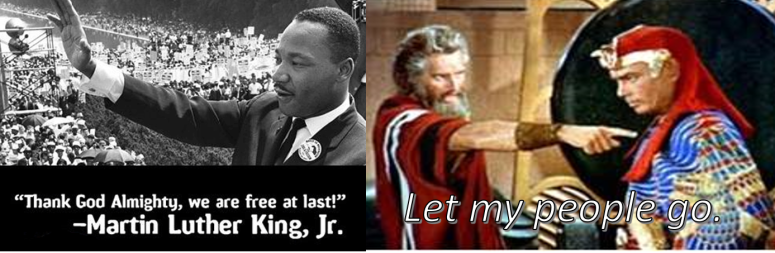
Afterward Moses and Aaron went to Pharaoh and said, “This is what the Lord, the God of Israel, says: ‘Let my people go, so that they may hold a festival to me in the wilderness.’”

16

Though secularism removes any hint of God from the public square, that’s difficult to do on a day when the work of the Reverend Martin Luther King, Jr. (MLK) is fondly remembered.  Apparently, that’s not the case for the hardcore secularists who, according to Stephen Carter, professor of law at Yale, treat MLK’S religious calling “as a relatively unimportant aspect of his career, if indeed, it is mentioned at all.”  Consider what Christopher Hitchens, author of God is not Great: How Religion Poisons Everything, says: “In no real as opposed to nominal sense, then, was [MLK] a Christian.”  How so?  Hitchens, who categorically classifies the Bible as a book spewing of violence, reasons that King couldn’t be a Christian since he wasn’t given to violence.  Sam Harris, another famed atheist, writes, “We simply do not need religious ideas to motivate us to live ethical lives.”  Whereas I refuse to dignify Hitchen’s illogic with a response, Harris’ view, in contrast, has its merits (see below)—but not in the case of MLK.

Indisputably, King, a man of extraordinary faith and courage, attained his vision from God: “Free at last, free at last; thank God Almighty, we are free at last.”  In “God Is Marching On” speech in Montgomery, Alabama, he quoted Micah 6:8, “Act justly and to love mercy and to walk humbly with your God,” to describe the kind of people whom the voters should elect to represent them—so much for the intellectual honesty of secularists.

On the other hand, there are those who, while stressing the heroics of MLK, sanitize his life to such a degree that it borders on the cult of personality.  It’s now a matter of public record that he wasn’t always faithful to his wife, and Boston University had considered (Time, Nov. 1990), but ultimately decided not to revoke King’s doctorate degree, despite finding that parts of his dissertation were plagiarized.  Nevertheless, I agree with Time article’s conclusion: “Even though the revelation may tarnish King’s reputation, they hardly diminish his courageous and inspirational accomplishments in helping to achieve racial justice for millions of black American.”  Anyone who has seen an old footage showing MLK and his fellow marchers never wavering from their just cause, even when batons and fire hoses were used to halt them, would agree.  Don’t be, then, too surprised at God using MLK in spite of him, not necessarily because of him; look no further than King David, erstwhile adulterer and murderer, for proof.  Subsequently, God receives all the glory, and thus, we are inspired to place our faith on Him, not on men.

Of course, we are far from being “a nation where [we] will not be judged by the color of [our] skin but by the context of [our] character.”  In fact, the situation in America has gotten more complicated as class now affects individual’s future prospect, argued Harvard sociologist William J. Wilson, as much as race. That is, the middleclass folks (whether black, white or yellow) judge those who aren’t included in their class more by where they live, what they do, and the level of their education than simply the color of one’s skin.  Either way, both racism and classism originate from the same source: a proud heart.

So, on this day, as we observe the birthday of the Reverend Martin Luther King Jr., an imperfect servant of God whose courageous vision carved out a path toward freedom for the oppressed (whether racial or class), let us “not be proud, but be willing to associate with people of low position.  Do not be conceited” (Rom. 12: 16).

Prayer: Father, You created all ethnic (ethnos) groups and the people therein, and we have all fallen short of Your glory.  It was for us that You sent your Son to do what no human government can do: forgiving our sins and making us righteous in Christ.  May You use my life and church to heal the nations (ethnos).  Amen.

Bible Reading for Today: 2 Kings 17


LUNCH BREAK STUDY

Read John 8:32-6: Then you will know the truth, and the truth will set you free.”  33 [The Jews] answered him, “We are Abraham’s descendants and have never been slaves of anyone. How can you say that we shall be set free?” 34 Jesus replied, “Very truly I tell you, everyone who sins is a slave to sin. 35 Now a slave has no permanent place in the family, but a son belongs to it forever. 36 So if the Son sets you free, you will be free indeed.”

Romans 2:14-5: (Indeed, when Gentiles, who do not have the law, do by nature things required by the law, they are a law for themselves, even though they do not have the law. 15 They show that the requirements of the law are written on their hearts, their consciences also bearing witness, and their thoughts sometimes accusing them and at other times even defending them.)

Question to Consider

  1. Martin Luther King was inspired by Moses, who boldly demanded freedom from Pharaoh (“Set my people free”). What kind of freedom was this?
  2. While the freedom that Moses sought was important and certainly was part of God’s will, Jesus expanded that freedom during his ministry to another—a greater freedom. What was Christ offering?
  3. The atheist Sam Harris says that “we simply do not need religious ideas to motivate us to live ethical lives.” Does Romans 2:14-5 lend support to his view?

Notes

  1. The freedom that Moses sought after was political and social freedom.
  2. The freedom that Christ offered then, and continue to offer today, is spiritual freedom; that is, being liberated from Satan’s rule, thanks to Christ who destroyed “the devil’s work” (1 Jn. 3:8; Heb. 2:14-15)
  3. God’s law written on human hearts is universal, meaning it is applicable to atheists as well as to Buddhists.  While the conscience may not work very well, due to man’s sinful nature and unhealthy environment, God, nevertheless, places it there so that “you, . . . though evil, know how to give good gifts to your children” (Mt. 7:11).  It is not for salvation but to maintain some semblance of social order and security for the wellbeing of all.

EVENING REFLECTION

Let’s spend this moment praying for a true racial reconciliation to occur in America.  Pray for a revival to break out among the men in blue across the nation.  Pray for the leaders of African-American community, that they may seek God’s wisdom and heart even as they cry out for justice and fairness.

January 15, Sunday

mei lan

Mei Lan Thallman is originally from Taiwan and a graduate of Asbury College and Asbury Theological Seminary (M.A.) in Kentucky.  She is the wife of Pastor Kirt, who serves at Grace Covenant Church (Philadelphia).  They have two children, Nate (14) and Naomi (12).

Pastor Ryun’s series returns on Monday.

Devotional Thoughts for Today


Be Bold for Christ  

Acts 6:8-15; 7:54-60

Now Stephen, a man full of God’s grace and power, performed great wonders and signs among the people. Opposition arose, however, from members of the Synagogue of the Freedmen (as it was called)—Jews of Cyrene and Alexandria as well as the provinces of Cilicia and Asia—who began to argue with Stephen. 10 But they could not stand up against the wisdom the Spirit gave him as he spoke.11 Then they secretly persuaded some men to say, “We have heard Stephen speak blasphemous words against Moses and against God.”12 So they stirred up the people and the elders and the teachers of the law. They seized Stephen and brought him before the Sanhedrin. 13 They produced false witnesses, who testified, “This fellow never stops speaking against this holy place and against the law. 14 For we have heard him say that this Jesus of Nazareth will destroy this place and change the customs Moses handed down to us.”15 All who were sitting in the Sanhedrin looked intently at Stephen, and they saw that his face was like the face of an angel.

15We saw yesterday how the early church grew rapidly, but so did the challenges, obstacles, and oppositions from both inside and out. From within, the church struggled with disunity due to conflicts and complains about unequal food distribution among the widows. God’s solution was to appoint Spirit filled leaders to meet practical needs while modeling and teaching godly principles and attitudes. In instructing the young flock to follow Christ, their objective was looking not only to their own interests, but also to the welfare of others in the church.

Today’s texts offer us a few snap shots of how the same Holy Spirit strengthened Stephen while facing fierce opposition from outside the church. Perhaps what was an amicable conversation about faith quickly turned into a heated debate. Then, those opposing Stephen quickly unleashed vendetta against him, trying to prove him wrong at any cost, but Stephen did not flinch from his conviction even as escalating condemnation and accusation led to his stoning. Subsequently, Stephen, facing the opposition in the fullness of the Holy Spirt, grace and power (Acts 6:15; 7:1-60), became the first martyr of NT era.

In our postmodern age of relativism and political correctness, we, as followers of Christ Jesus, must prepare and brace ourselves for increasing opposition and persecution against our core belief and conviction; the obedience to the gospel in all areas of our lives must be sustained. As we have just started the New Year to follow and serve Jesus wholeheartedly, we must seek and rely on God’s supernatural anointing and empowerment to deal with hostility against our faith in His love and grace.

May we be reminded that apart from Him we can do nothing; but with Him we can do all things through His love, grace and strength. May we aspire to embody the humble heart of Stephen to serve and love the family of Christ, addressing their needs, both visible and unspoken, as unto the Lord. May we have the courage to speak up for Jesus and defend our faith even at the risk of being ridiculed and rejected by those who hold Christianity in contempt. May we extend God’s unconditional love and forgiveness to those who are hostile toward us like Stephen did (Acts7:60).

Prayer: Dear Lord Jesus, as we ponder on the outcome of Stephen’s life, there is no logical reason other than he was a man completely captured by the fullness of Christ. He was so filled with You that there was nothing he wasn’t willing to do, from serving tables to defend the gospel to dying for His beloved Jesus; he lived his life with such reckless devotion, grace and humility. May You captivate our generation and fill us as You did for Stephen, so that we may truly make an impact in this world for your glory. In your matchless name, Amen.

Bible Reading for Today: 2 Kings 16

January 14, Saturday

mei lan

Mei Lan Thallman is originally from Taiwan and a graduate of Asbury College and Asbury Theological Seminary (M.A.) in Kentucky.  She is the wife of Pastor Kirt, who serves at Grace Covenant Church (Philadelphia).  They have two children, Nate (14) and Naomi (12).

Pastor Ryun’s series returns on Monday.

Devotional Thoughts for Today

An Antidote for “Me” Leadership

Acts 6:1-8

In those days when the number of disciples was increasing, the Hellenistic Jews among them complained against the Hebraic Jews because their widows were being overlooked in the daily distribution of food. So the Twelve gathered all the disciples together and said, “It would not be right for us to neglect the ministry of the word of God in order to wait on tables. Brothers and sisters, choose seven men from among you who are known to be full of the Spirit and wisdom. We will turn this responsibility over to them and will give our attention to prayer and the ministry of the word.”5 This proposal pleased the whole group. They chose Stephen, a man full of faith and of the Holy Spirit; also Philip, Procorus, Nicanor, Timon, Parmenas, and Nicolas from Antioch, a convert to Judaism. They presented these men to the apostles, who prayed and laid their hands on them.7 So the word of God spread. The number of disciples in Jerusalem increased rapidly, and a large number of priests became obedient to the faith.  8 Now Stephen, a man full of God’s grace and power, performed great wonders and signs among the people. 

“What’s for dinner?” is one of the most repeated questions I hear from my kids.  Their just-eat-itresponse to my answer can either place a smile on my face—or drop an atomic bomb in my spirit.  After all the effort I put into making a meal, the last thing I want to hear is “Are you making that again?” or “I don’t like that.” So, at the dinner table, I often need to rely on the power of the Holy Spirit to help me to maintain a loving attitude and to zip my mouth from unleashing well-deserved rebuke to my unappreciative, complaining, and expert food critiquing family. Ironically, this situation helps me to understand why the Holy Spirit impressed Luke to emphasize the leadership qualifications to care for the practical needs of a growing church family.

Upon examining Acts 6, a few important spiritual principles stand out. First, there is no distinction in God’s eyes: one ministry is not more important than the other; both spiritual and practical needs of the church family are equally important.  Second, God’s criteria for leadership qualities to meet both needs are also the same. It’s very fascinating how the text repeatedly emphasizes the importance of choosing leaders who are known to be “full of the Spirit, wisdom, God’s grace and God’s power” (v.3, 5, 8).

The early church is experiencing growth explosion and increasing responsibilities to care for the diversifying needs of the congregation.  The twelve apostles recognized the need to expand their leadership team in order to adequately shepherd the young and fast growing flock. Seven men were appointed with the primary responsibility to wait on tables. The Greek word for “wait on” is the verb from which the noun “deacon” comes from.

Acts 6 used to puzzle me, because I felt like these seven men were overqualified to wait on tables.  Anybody can wait on tables. When we are known to be full of the Spirit, wisdom, and God’s grace and power, we often think that we are suitable for more important tasks—like teacher, elder, worship leader, small group leader, etc. But having received from the Lord this awesome privilege of serving Him for past 20+ years, I understand that who we are is much more important than what we do. God always looks for leaders who lead out of who they are and not just what they do (title or position). I praise God for placing the priority on the quality of our heart and character over our natural ability and talents. I’m glad that none of the seven responded that they were too spiritual, too qualified, and too good to wait on tables; instead, they accepted the call with humility, availability, and deep gratitude for what Jesus had done for them.

Prayer: Lord, as we begin 2017 it is our heart’s cry to become men and women who are characterized to be “full of Holy Spirit, godly wisdom, God’s grace and power.”  As we face the challenges of our time, we can all agree this world is in desperate need for more leaders with the spirit of Stephen in our homes, churches, schools, work places, country and world. The Holy Spirit who lived in and through Stephen is the same Person who indwells with all believers of Jesus Christ. Lord, empower us to take a bold and firm stand in our generation and to be a faithful steward of the influences you have entrusted to us.  In Christ Jesus’ overcoming name. Amen.