 The AMI QT Devotionals July 17-23 are written by David Son, who serves as the college pastor at Symphony Church in Boston. David, a graduate of UC Berkeley (B.S.) and Gordon-Conwell Seminary (M.Div.), is married to Grace who teaches at a public school.
DEVOTIONAL THOUGHTS FOR TODAY
Gospel Contextualization
Galatians 2:7-9
On the contrary, when they saw that I had been entrusted with the gospel to the uncircumcised, just as Peter had been entrusted with the gospel to the circumcised (for he who worked through Peter for his apostolic ministry to the circumcised worked also through me for mine to the Gentiles), and when James and Cephas and John, who seemed to be pillars, perceived the grace that was given to me, they gave the right hand of fellowship to Barnabas and me, that we should go to the Gentiles and they to the circumcised.
 Last year, there was a huge debacle concerning Epi-pens. If you’re unfamiliar with the product, it’s a handheld device that is used to inject 0.3 milligrams of epinephrine into someone who is having a severe allergic reaction or going through anaphylactic shock. The reason Epi-pens were in the news was because of the outrageous jump in price. What used to be only $50 suddenly skyrocketed to $400 per Epi-pen.
Interestingly, the actual cost of one dose of epinephrine is roughly 10 cents! Why, then, were people shelling out $400 for an Epi-pen? Because they were paying for the “delivery system.” The delivery system is just as important as the substance being delivered. See, you can’t just swallow a spoon of epinephrine; it is only effective if it is injected into the body using the appropriate delivery system.
In a similar way, the gospel must also be accompanied by a thoughtful, appropriate, delivery system. In our passage today, we see the leaders of the early church acknowledging and affirming that ministering to the circumcised Jews and the uncircumcised Gentiles required different “delivery systems.” This is called contextualization. The gospel message has always remained the same, but the delivery method has necessarily changed across the various cultures, languages, traditions, and generations. Of course a delivery system without explicit gospel content is just like an Epi-pen without epinephrine: empty and useless. But the gospel message without proper, thoughtful contextualization can also often lead to misunderstandings.
This morning I want to invite you to consider your delivery system for the gospel. How can you effectively contextualize the gospel message for your campus/workplace/home? Ask the Holy Spirit for insight as to how you can better communicate the Good News to those around you.
Prayer: Holy Spirit, teach me how to be a deliverer of Good News to those You’ve placed around me. Today, open my eyes to opportunities to minister to my classmates/coworkers/ friends/family. Give me wisdom and boldness. In Jesus’ name I pray. Amen.
Bible Reading for Today: Joshua 17
Lunch Break Study
Read Acts 17:22-25; 30-31: So Paul, standing in the midst of the Areopagus, said: “Men of Athens, I perceive that in every way you are very religious. For as I passed along and observed the objects of your worship, I found also an altar with this inscription: To the unknown god.’ What therefore you worship as unknown, this I proclaim to you. The God who made the world and everything in it, being Lord of heaven and earth, does not live in temples made by man, nor is he served by human hands, as though he needed anything, since he himself gives to all mankind life and breath and everything… The times of ignorance God overlooked, but now he commands all people everywhere to repent, because he has fixed a day on which he will judge the world in righteousness by a man whom he has appointed; and of this he has given assurance to all by raising him from the dead.
Questions to Consider
- To whom is Paul preaching the gospel to?
- How does Paul contextualize the gospel to these people?
- How is this gospel presentation different from others we see in Scripture?
Notes
- Paul is in Athens, preaching to Greek Gentiles. He mentions that they are a very religious people.
- Paul uses the spirituality of the Athenians as an entry point for the gospel message. He notices that they even have an altar to “an unknown god.” Seeing their desire to worship deities, Paul begins his gospel presentation by establishing that there is but one true God, who is bigger than creation and uncontainable by temples. He concludes his message by calling the Athenians to repent and turn to the true God.
- This is the same gospel message, but a very different delivery system than the ones we see presented to the Jews. First, there is no mention of the Law or circumcision. In nearly every case where the gospel is preached to the Jews, it begins with Moses and the Law. But the Mosaic Law means little to nothing to the Athenians, and so Paul has no need to mention it. Also, interestingly, Paul doesn’t mention the name Jesus yet. He merely refers to Jesus by calling Him “a man whom [God] has appointed.” Perhaps this is because Jesus (Yeshua) is a Hebrew name, and mentioning a Hebrew name might have immediately lost much of his audience. Paul knows that without Christ there is no gospel, but at the same time, he refers to Jesus without mentioning His Hebrew name in order to contextualize to the Athenians.
Evening Reflection
This evening, spend some time praying for those around you who do not yet know Jesus. While thoughtful contextualization is something we must continue to work on, at the end of the day, the Holy Spirit must soften and turn hearts towards Him. Let’s ask the Spirit to move in our city.
 A little while ago, I was gifted an Amazon Echo named Alexa. One of the most interesting features of this device is the “Casual Compliment Machine.” Basically when you enable this feature, you can call upon Alexa to spew all sorts of kind words to you. I haven’t tried this feature out yet, but I don’t doubt that aside from the initial hilarity, it could marginally increase my self-esteem.
 Yesterday, as we covered the above passage in Exodus, I mentioned the American proverb “The squeaky wheel gets the grease”, meaning that the loudest cries best attract help. In the passage, the Israelites cried out loudly–in their prayers, in their groaning, in their desperation for God to return their freedom.
 Do you know the saying “The squeaky wheel gets the grease?” According to Wikipedia, it’s a proverb used to “convey the idea that the most noticeable (or loudest) problems are the ones most likely to get attention.”
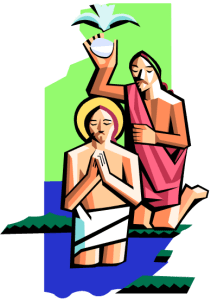 After He was baptized, three of the four Gospel writers point out that Jesus, filled with the Holy Spirit, was led into the wilderness for forty days. As I was reading the passage this time around, it dawned on me that according to conventional human wisdom, the moment right after the baptism would have been most ideal for public ministry. Think about it: when Jesus was baptized by John, the heavens opened up and the visible presence of the Holy Spirit descended upon Him. This was no secluded matter, as many had come to be baptized by John in the Jordan River. How could you not believe someone if you saw the very presence of the Holy Spirit fall upon Him, not to mention hearing an audible voice saying, “This is my son in whom I am well pleased”? If I were Jesus’ PR manager, I would have told Him to start His ministry now.
 Many of us are familiar with the story of the paralyzed man who was lowered through a roof. The faith of his friends seems central to the miracle and, of course, it is important. Yet what often goes less appreciated is the incredible hospitality of Jesus.
 The AMI QT Devotionals from July 11-12 are provided by Emerson Lin. Emerson, a graduate of University of California, San Diego, serves as a staff at Kairos Christian Church, while studying at Talbot School of Theology. He is married to Annie.
 In my freshman year of college, I played pick-up basketball with my suitemates. One particular game I ran toward the basket for a layup and jammed my thumb, swelling it fiercely. For days after, I couldn’t use chopsticks, open jars or even grab a tooth brush. I didn’t realize that such a small part of my body could be so valuable!
 In 2014, Psychology Today came out with an article titled “7 Ways Facebook is bad for our mental health,” arguing that the website can make people feel like their lives aren’t as exciting as everyone else’s or even leading us to envy our friends’ successes.
 After being attacked, arrested, beaten with rods, thrown in jail, and put into the stocks, Paul and Silas have little idea what will happen to them next. Yet what are they doing at midnight? Singing.
 Jennifer Kim, a graduate of Boston University, spent a year in Shanghai as one-year intern from 2013-14. She is currently serving as a staff at Catalyst Agape Church (New Jersey), while attending Alliance Theological Seminary.
 Growing up I had one dream in life, and unlike most kids, my dream never changed: I wanted to be the first female Asian Spielberg. To kick-start this dream, when I was in 6th grade I asked my parents for a very specific camcorder—the Sony DCR-TRV22. Now this camcorder was the most state-of-the-art recorder of its day, and I took care of this thing like it was my baby! This camera was my most prized possession because at the heart of it, I believed it would bring me closer to my dream of becoming Director Jennifer Kim.