 The AMI QT Devotionals from October 16-22 are provided by Pastor Shan Gian, who serves as the Fenway site pastor of Symphony Church in Boston. Shan, a graduate of University of Pennsylvania and Gordon Conwell Seminary (M.Div.), is married to Jenny; and they are the proud parents of their first baby Tyler.
Devotional Thoughts for Today
“Being Rich”
Genesis 13:1-4
So Abram went up from Egypt, he and his wife and all that he had, and Lot with him, into the Negeb. 2 Now Abram was very rich in livestock, in silver, and in gold. 3 And he journeyed on from the Negeb as far as Bethel to the place where his tent had been at the beginning, between Bethel and Ai, 4 to the place where he had made an altar at the first. And there Abram called upon the name of the Lord.
 Many of us tend to have a paradoxical view of wealth and possessions. While so many people strive for greater and greater wealth, these same people feel contempt towards those who have great wealth. One example of this is how much people love the classic stories of Robin Hood. They are exciting and inspiring stories about the bravery of Robin Hood and his merry outlaws as they fight injustice. Robin Hood is a hero to most because he steals from the rich to give to the poor, yet people tend to ignore the fact that what he’s doing is theft; and since most people themselves would love to be rich, Robin Hood would be stealing from them!
Some have a negative view of the wealthy for a variety of reasons: perhaps we think of the wealthy as being conceited, selfish, or entitled. Yet at the same time, most people would love to have that problem.
In Genesis 13, it is made very clear that Abram is very rich. He is loaded with tons of livestock, silver and gold. If Abram were our neighbor, he would’ve been the one with the biggest house, the nicest cars, and the best clothes. But what we see about Abram’s life in this passage is far from any mental picture we have of conceited, rich people. Instead, we see from Genesis a man who is not defined by what he has but in whom he trusts with his life. He is not this selfish or entitled man who looks down on others or don’t have need for others; instead, we meet a man who trusted not in himself, but called upon the name of the Lord in worship.
Having lots of money or possessions is not inherently wrong or sinful, but they can lead us to be conceited or entitled if they define us and lead us away from trusting in God. In fact the opposite can be true as well: not having a lot of money and possessions can lead us away from trusting in God if in our lack, there is an unhealthy striving for more. The only way for us to have a healthy relationship with our possessions and wealth is to follow Abram’s example—and that is to call upon the name of the Lord and worship Him and Him alone. Let us not be defined by our possessions and wealth but let us seek to trust only in God!
Prayer: Jesus, I entrust my life to You today. I pray that I will not let myself be defined but what I have or don’t have, but instead, I will be defined by who You are and what You have done for me. Amen.
Bible Reading for Today: Acts 7
Lunch Break Study
Read 1 Timothy 6:6-10: But godliness with contentment is great gain, 7 for we brought nothing into the world, and we cannot take anything out of the world. 8 But if we have food and clothing, with these we will be content. 9 But those who desire to be rich fall into temptation, into a snare, into many senseless and harmful desires that plunge people into ruin and destruction. 10 For the love of money is a root of all kinds of evils. It is through this craving that some have wandered away from the faith and pierced themselves with many pangs.
Questions to Consider
- What is the biggest enemy of contentment, according to this passage?
- Verse 10 is often misquoted as saying that the “money is the root of all evil” instead of “the love of money is the root of all kinds of evil.” There’s a slight difference in wording but there’s a drastic difference in meaning and application. What is the difference for our lives?
- How have you seen the love of money be a hindrance to your own walk with God? What steps can we take to be more content?
Notes
- The biggest enemy of contentment is the love of money—the desire to be rich. This love/desire is what plunges “people into ruin and destruction” and leads them away from faith.
- To say that “money is the root of all evil” implies that money itself is what corrupts us, which is wrong because is money is not inherently good or bad; rather, it is “love of money” that is the source of “all kinds of evil.” And that means that it is the sinful desires of our own hearts that is the source of many kinds of evil. Money is not the problem but it is our relationship with money that leads us away from contentment and trusting in God.
- Personal reflection question.
Evening Reflection
In what ways are you defining yourself by your possessions or wealth? The desire for more is something that we all struggle with and something that we all need to bring before God in prayer. Surrender your heart and desires to God and seek to trust in Him alone.
 The AMI QT Devotionals from October 9-15 are provided by Pastor Peter Yoon of Kairos Christian Church in San Diego. Peter is a graduate of U.C. Riverside and Talbot School of Theology (M.Div.). He and his wife Jessica have three very active children: Nathan, Abigail, and Jason.
 If you could lie about something and not only get away with it but receive nice benefits along the way, would you do it?
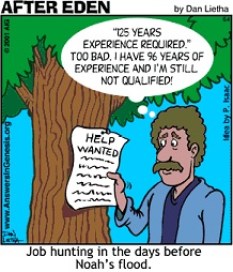 On the positive side, I thought, we’d be really good at developing some of our skillsets. Could you imagine playing basketball for 438 years of your life? You’d be really good. But on the flip side, could you imagine working for another 438 years at your job? Even if you love your job, you’re probably saying to yourself, “No thank you.”
 The AMI QT Devotionals from October 9-15 are provided by Pastor Peter Yoon of Kairos Christian Church in San Diego. Peter is a graduate of U.C. Riverside and Talbot School of Theology (M.Div.). He and his wife Jessica have three very active children: Nathan, Abigail, and Jason.
 We understand that faith plays a critical role in our Christian life. Faith is critical for our salvation. Faith moves mountains. Faith heals people. In fact, without faith, we know it is impossible to please God (Heb. 11:6). But if we are honest, we often struggle with doubts. Many in the church wonder if they are genuinely saved. Mountains still remain while healings are sparse. It’s easy to scrutinize ourselves and have a low view of our own faith.
 Years ago, Jessica and I were ministering at a retreat, and we sensed that some of the people present wanted to get closer to the Lord; yet, they were hesitating. It was there that I identified one of the reasons why believers hesitate to follow Jesus fully (with one foot on the brake): They have this notion that should they wholeheartedly commit to Jesus, God will immediately send them packing as missionaries to the “ends of the earth,” where they will suffer miserably under harsh conditions.
 One afternoon, I took my son, Nathan, to H-Mart, a local Korean grocery store. At the check-out line, I spoke to the cashier in Korean. My son looked stunned that a foreign language was coming out of my mouth. With confusion in his eyes, he said, “I didn’t know you can speak Spanish.” I had a good laugh sharing that story with my wife later that evening. However, when confusion is a result of misinterpretations and misunderstandings, it is quite frustrating. Even when speaking the same language with one another, how often our miscommunications and misunderstandings have impeded a project, or worse, wrecked a relationship?
 Many cities in the US are given nicknames that reveal their civic identities. These nicknames can sometimes provide a sense of community for its residents as well as a sense of civic pride. I do sense a bit of pride about my city having its nickname. Does your city’s nickname give you a sense of pride?
 Churches are filled with many young impressionable believers that can make discipleship exciting. However, at times, it’s unfortunate when someone in the church twists God’s grace into a license to sin. It is true that no person is required to observe the OT Law as a means for salvation; the gospel of Jesus Christ is that Heaven is absolutely a free gift; and no church attendance or offering money is at all required for salvation. This is because when Jesus died on the cross, He fulfilled the OT Law (Rom. 10:4; Gal. 3:23-25). However, the unbiblical conclusion is that there’s nothing that God expects of Christians in terms of a disciplined life in God’s Spirit, and some begin to think, “If I’m saved by grace and all of my sins, past, present, and future, are forgiven, why not sin all I want?”
 The AMI QT Devotionals for October 2-8 are provided by Doug Tritton. Doug, a graduate of University of Pennsylvania, is currently serving as a staff at Symphony Church (Boston) while pursuing a M.Div. at Gordon Conwell Seminary. He is married to Cindy and they are proud parents of Audrey.
 If the Bible names someone “mighty”, this is important to notice. Typically, God is the One described as mighty, the One who fights for His people like a mighty warrior. David also had his mighty men, the people whom he trusted above all else. But here, we have this person Nimrod described as a mighty man and a mighty hunter, even though he is in the lineage of Ham, the one who was cursed in the previous chapter. In fact, in this genealogy, the story of Nimrod stands out, since he gets a special shout-out, unlike anyone else listed in the genealogy.
 Genealogies can be difficult to read in the Old Testament. Often, we may think to ourselves, “I can just skip these chapters and move onto the important parts of the Bible.” This is certainly tempting, but these chapters are also God’s word, so we should not ignore them.