October 18, Wednesday

The AMI QT Devotionals from October 16-22 are provided by Pastor Shan Gian, who serves as the Fenway site pastor of Symphony Church in Boston. Shan, a graduate of University of Pennsylvania and Gordon Conwell Seminary (M.Div.), is married to Jenny; and they are the proud parents of their first baby Tyler.

Devotional Thoughts for Today

“It seemed like a good idea at the time…”

Genesis 13:10-13

And Lot lifted up his eyes and saw that the Jordan Valley was well watered everywhere like the garden of the Lord, like the land of Egypt, in the direction of Zoar. (This was before the Lord destroyed Sodom and Gomorrah.) 11 So Lot chose for himself all the Jordan Valley, and Lot journeyed east. Thus they separated from each other.  12 Abram settled in the land of Canaan, while Lot settled among the cities of the valley and moved his tent as far as Sodom.13 Now the men of Sodom were wicked, great sinners against the Lord.

“It seemed like a good idea at the time…” is the start of many stories of regret. For me, every time I drive by a KFC or Popeyes, it seems like a great idea to go and get a bucket of some fried chicken; but every time I’ve done it, it’s ended up in regret because of an upset stomach or a debilitating food coma. Whether it’s making that purchase, going to that particular event, hanging out with that crowd, or dating that person, all of these things that we regret later on started off as great ideas.

I could imagine this is what Lot was thinking as he surveyed the land that was before him: His uncle Abram had offered to let him choose the land that he would settle in, so Genesis tells us that Lot “lifted his eyes.” He looked up at the Jordan Valley, and at the time, it seemed like a great idea to take the land that was green and lush and well watered, making a decision based on what his eyes were fixed on. But what was a great idea at the time ended up in disaster, as we discover later in Genesis 19. And that disaster came because while Lot’s eyes saw the lush and well watered land, they failed to notice what the people there were like: verse 13 notes that Lot’s neighbors of Sodom were wicked and great sinners.

The story of Lot is a warning for us to avoid lives of regret and to not make choices based on what our human eyes can see. Every bad decision that has ever been made seemed like a good idea at the time because every bad decision is made based on what we see with our own eyes. When we it comes to the crossroads of our lives, when there are decisions to be made—big or small—instead of trusting our own eyes or our own point of view, we need to depend on the perspective of the One who can see all.

Prayer: Jesus, help me through every decision I make today. I don’t want to look back on this day with regret, but instead, I pray that You will help me to choose to follow You and find joy in my walk with You this day. Amen.

Bible Reading for Today: Acts 9


Lunch Break Study

Read Ephesians 5:15-17: Look carefully then how you walk, not as unwise but as wise,16 making the best use of the time, because the days are evil.17 Therefore do not be foolish, but understand what the will of the Lord is. 

Questions to Consider

  1. Why should we be careful about how we walk?
  2. What does “making the best use of time” have to do with walking carefully or living with wisdom?
  3. How can we make the most of every decision in our lives with wisdom?

Notes

  1. Paul is telling us to be careful because “the days are evil.” When he says “look carefully then how you walk,” it’s a picture of walking on a dangerous path where it might be easy to slip and fall. So this exhortation to be careful how we walk is because the days are evil and it’s easy to stumble or slip if we’re not careful and intentional about how we live our lives.
  2. “Making the best use of time” can also be understood as “making the most of every opportunity.” In an economic sense, it would be like trying to maximize the amount of money we make in every sale or deal. But when it comes to our spiritual lives, it means living our lives in such a way that maximizes God’s glory and our own joy. And so when Paul is exhorting us to live with wisdom, it means that we should walk carefully and intentionally, in such a way that we don’t slip and fall but that God is glorified, and we find joy in our relationship with Him.
  3. We should do as Paul commands and look carefully how we walk, but we should also note what he says at the end of verse 17: “understand what the will of the Lord is.” In any decision we make, big or small, whether it’s what job to take or what to eat for lunch, we should seek to understand God’s will for us.

Evening Reflection

Consider some of the choices you made today. Were they wise decisions or do you regret some of them already? While we are encouraged to walk carefully with wisdom, we should not expect to walk perfectly on this side of heaven. Bring your successes and failures of today to Jesus and thank Him for his grace.

October 17, Tuesday

The AMI QT Devotionals from October 16-22 are provided by Pastor Shan Gian, who serves as the Fenway site pastor of Symphony Church in Boston. Shan, a graduate of University of Pennsylvania and Gordon Conwell Seminary (M.Div.), is married to Jenny; and they are the proud parents of their first baby Tyler.

Devotional Thoughts for Today

“Being Second”

Genesis 13:5-9

And Lot, who went with Abram, also had flocks and herds and tents, 6 so that the land could not support both of them dwelling together; for their possessions were so great that they could not dwell together, 7 and there was strife between the herdsmen of Abram’s livestock and the herdsmen of Lot’s livestock. At that time the Canaanites and the Perizzites were dwelling in the land. 8 Then Abram said to Lot, “Let there be no strife between you and me, and between your herdsmen and my herdsmen, for we are kinsmen. 9 Is not the whole land before you? Separate yourself from me. If you take the left hand, then I will go to the right, or if you take the right hand, then I will go to the left.” 

In our world, we place a premium on being first in line. If we’re about to check out of the grocery store, we hope to be the first in line at the register. When it’s opening night of a new blockbuster movie, we want to be first in line if we can. And of course when there’s a big job promotion coming up, we want to be first in line to receive it. Being first in line means more opportunities, more choices, better seats, higher income, etc. So, of course, if we have the choice, we’ll always choose to be first in line.

However, in our passage, Abram goes completely against this tendency and instead chooses to be second. Genesis 13 tells us that there was strife between Abram and Lot’s households, and so Abram knows that the best solution for him and his nephew is to go their separate ways. At this point, Abram had every right to be first in line. Abram was not only older than Lot, but as his uncle, he had familial authority over Lot. Also, Abram knew he was favored by God. He was entitled to put himself first in line to choose the best land for settlement. Yet despite the power and privilege that could have easily justified a choice to be first, Abram chose to be second.

Why would anyone choose to be second? Abram was willing to give up his place in line out of love for Lot. Love is demonstrated by our willingness to put others before ourselves, and Abram clearly loved Lot because he gave up his power and privilege for the sake of his nephew. Every day we carry an entitlement that drives our desire to be first; to walk through a door first, to take what we deserve, to have first pick. But each day yields opportunities to be second and to demonstrate love to our family members, friends, co-workers and the world by giving up our privilege and putting others before ourselves. If we choose to be second, we’re not only demonstrating our love to others, but we’re demonstrating the sacrificial love of Jesus to the world. Let’s strive to be second today!

Prayer: Jesus, help me to lay down my privilege and entitlement and put others before myself this day. I remember that this is what You did as you humbled yourself on the cross for us. I pray that I can love others like You love me. Amen.

Bible Reading for Today: Acts 8


Lunch Break Study

Read Philippians 2:1-4: So if there is any encouragement in Christ, any comfort from love, any participation in the Spirit, any affection and sympathy, 2 complete my joy by being of the same mind, having the same love, being in full accord and of one mind. 3 Do nothing from selfish ambition or conceit, but in humility count others more significant than yourselves. 4 Let each of you look not only to his own interests, but also to the interests of others.

Questions to Consider

  1. According to this passage, from where do we find the foundation for humility?
  2. What is the definition of humility according to Philippians 2? How might this go against our own definitions of humility?
  3. How can we have more humility in our lives? What keeps us from being humble?

Notes

  1. The foundation is found in verse 1, where Paul tells us to be humble on the condition that we have received any encouragement in Christ, any comfort from love or any work of the Spirit or any affection or sympathy. In sum, the foundation of humility is if we have received anything from Jesus.
  2. The definition of humility from this passage would be to count others more significant than ourselves by looking out for the needs of others. Humility is not looking down on ourselves or thinking of ourselves as worthless, lowly, or and poor. Humility is putting others before ourselves in spite of our own privilege or entitlement.
  3. Humility has to start with our relationship with Jesus. If we spend time with Jesus, then we will come to realize that humility comes from experiencing grace, and not because of our own works. When we recognize this, it empowers us to let go of privilege or entitlement and to put others first and ourselves second. What keeps us from being humble is when we put ourselves not only before others but above Jesus himself.

Evening Reflection

Think about the events of this day. Did you have opportunities to be second today, and if so, did you take them? It’s hard for us to let go of entitlement because we’re naturally selfish; it is only through God’s grace that we can genuinely put the needs of others before our own. However this day was, go to Jesus tonight and ask Him for the strength and humility to love others.

October 16, Monday

The AMI QT Devotionals from October 16-22 are provided by Pastor Shan Gian, who serves as the Fenway site pastor of Symphony Church in Boston. Shan, a graduate of University of Pennsylvania and Gordon Conwell Seminary (M.Div.), is married to Jenny; and they are the proud parents of their first baby Tyler.

Devotional Thoughts for Today

“Being Rich”

Genesis 13:1-4

So Abram went up from Egypt, he and his wife and all that he had, and Lot with him, into the Negeb. 2 Now Abram was very rich in livestock, in silver, and in gold. 3 And he journeyed on from the Negeb as far as Bethel to the place where his tent had been at the beginning, between Bethel and Ai, 4 to the place where he had made an altar at the first. And there Abram called upon the name of the Lord. 

Many of us tend to have a paradoxical view of wealth and possessions. While so many people strive for greater and greater wealth, these same people feel contempt towards those who have great wealth. One example of this is how much people love the classic stories of Robin Hood. They are exciting and inspiring stories about the bravery of Robin Hood and his merry outlaws as they fight injustice. Robin Hood is a hero to most because he steals from the rich to give to the poor, yet people tend to ignore the fact that what he’s doing is theft; and since most people themselves would love to be rich, Robin Hood would be stealing from them!

Some have a negative view of the wealthy for a variety of reasons: perhaps we think of the wealthy as being conceited, selfish, or entitled. Yet at the same time, most people would love to have that problem.

In Genesis 13, it is made very clear that Abram is very rich. He is loaded with tons of livestock, silver and gold. If Abram were our neighbor, he would’ve been the one with the biggest house, the nicest cars, and the best clothes. But what we see about Abram’s life in this passage is far from any mental picture we have of conceited, rich people. Instead, we see from Genesis a man who is not defined by what he has but in whom he trusts with his life. He is not this selfish or entitled man who looks down on others or don’t have need for others; instead, we meet a man who trusted not in himself, but called upon the name of the Lord in worship.

Having lots of money or possessions is not inherently wrong or sinful, but they can lead us to be conceited or entitled if they define us and lead us away from trusting in God. In fact the opposite can be true as well: not having a lot of money and possessions can lead us away from trusting in God if in our lack, there is an unhealthy striving for more. The only way for us to have a healthy relationship with our possessions and wealth is to follow Abram’s example—and that is to call upon the name of the Lord and worship Him and Him alone. Let us not be defined by our possessions and wealth but let us seek to trust only in God!

Prayer: Jesus, I entrust my life to You today. I pray that I will not let myself be defined but what I have or don’t have, but instead, I will be defined by who You are and what You have done for me. Amen.

Bible Reading for Today: Acts 7


Lunch Break Study

Read 1 Timothy 6:6-10: But godliness with contentment is great gain, 7 for we brought nothing into the world, and we cannot take anything out of the world. 8 But if we have food and clothing, with these we will be content. 9 But those who desire to be rich fall into temptation, into a snare, into many senseless and harmful desires that plunge people into ruin and destruction. 10 For the love of money is a root of all kinds of evils. It is through this craving that some have wandered away from the faith and pierced themselves with many pangs.

Questions to Consider

  1. What is the biggest enemy of contentment, according to this passage?
  2. Verse 10 is often misquoted as saying that the “money is the root of all evil” instead of “the love of money is the root of all kinds of evil.” There’s a slight difference in wording but there’s a drastic difference in meaning and application. What is the difference for our lives?
  3. How have you seen the love of money be a hindrance to your own walk with God? What steps can we take to be more content?

Notes

  1. The biggest enemy of contentment is the love of money—the desire to be rich. This love/desire is what plunges “people into ruin and destruction” and leads them away from faith.
  2. To say that “money is the root of all evil” implies that money itself is what corrupts us, which is wrong because is money is not inherently good or bad; rather, it is “love of money” that is the source of “all kinds of evil.” And that means that it is the sinful desires of our own hearts that is the source of many kinds of evil. Money is not the problem but it is our relationship with money that leads us away from contentment and trusting in God.
  3. Personal reflection question.

Evening Reflection

In what ways are you defining yourself by your possessions or wealth? The desire for more is something that we all struggle with and something that we all need to bring before God in prayer. Surrender your heart and desires to God and seek to trust in Him alone.

October 15, Sunday

The AMI QT Devotionals from October 9-15 are provided by Pastor Peter Yoon of Kairos Christian Church in San Diego.  Peter is a graduate of U.C. Riverside and Talbot School of Theology (M.Div.).  He and his wife Jessica have three very active children: Nathan, Abigail, and Jason.

Devotional Thoughts for Today

“Lying with Benefits”

Genesis 12:11-17

As he was about to enter Egypt, he said to his wife Sarai, “I know what a beautiful woman you are. 12 When the Egyptians see you, they will say, ‘This is his wife.’ Then they will kill me but will let you live. 13 Say you are my sister, so that I will be treated well for your sake and my life will be spared because of you.” 14 When Abram came to Egypt, the Egyptians saw that Sarai was a very beautiful woman. 15 And when Pharaoh’s officials saw her, they praised her to Pharaoh, and she was taken into his palace. 16 He treated Abram well for her sake, and Abram acquired sheep and cattle, male and female donkeys, male and female servants, and camels. 17 But the LORD inflicted serious diseases on Pharaoh and his household because of Abram’s wife Sarai. 

If you could lie about something and not only get away with it but receive nice benefits along the way, would you do it?
I know lying to parents is a serious matter, for I cannot see a bit of humor when my children lie to me. Jason’s lips and mouth will be covered with residues of ice cream, and when I ask him, “What did you just eat before dinner?” he will actually say, “Nothing,” thinking that he can actually get away with it. My other son once attempted to have me sign a form, stating that I had reviewed his poorly taken exam; he knew that in my busyness, I’d sign anything trustingly, whereas his mother would thoroughly inspect the form before signing it.

We’ve all tried to fool our parents as kids. But on a more serious note, where do you find yourself still trying to fool others, because either you can get away with it, or you find yourself in a more beneficial state than before?

Abram must have been a pretty good liar. He fools Pharaoh along with all of the Egyptian officials into believing that Sarai was indeed Abram’s sister and not his wife. As a result, Pharaoh treated Abram “well for her sake, and Abram acquired sheep and cattle, male and female donkeys, male and female servants, and camels.” Abram came into Egypt fearing for his life, but by lying he had received a king’s hospitality and generosity.

Thankfully, the omniscient Lord had a different and better purpose for Abram and Sarai. Their lives weren’t destined for a life of opulence in a foreign land while living under the guile as siblings (poor Sarai, I can’t imagine what she was thinking)—it was much more than that. They were called from a pagan land to have a friendship with God and start a family which would eventually become a nation through whom the Savior of the world would arrive on earth. We try to fool others to gain fame, reputation, wealth, or just about anything that seem to benefit us; and we might even get really good at fooling others. However, our omniscient Lord cannot be fooled, nor does He allow His people to sow into deception. Because He loves us so much and has a totally different destiny for our lives, He just might let truth surface so that we might be free.

Prayer: Lord, You are the God of truth. Help me to trust in You and live in truth. In Jesus’ name.
Amen.

Bible Reading for Today: Acts 6

October 14, Saturday

The AMI QT Devotionals from October 9-15 are provided by Pastor Peter Yoon of Kairos Christian Church in San Diego.  Peter is a graduate of U.C. Riverside and Talbot School of Theology (M.Div.).  He and his wife Jessica have three very active children: Nathan, Abigail, and Jason.

Devotional Thoughts for Today

“Another 438 Years?”

Genesis 11:10-26

Patriarch Age Bible Reference
Shem 600 Genesis 11:10–11
Arphaxad 438 Genesis 11:12–13
Shelah 433 Genesis 11:14–15
Eber 464 Genesis 11:16–17
Peleg 239 Genesis 11:18–19
Reu 239 Genesis 11:20–21
Serug 230 Genesis 11:22–23
Nahor 148 Genesis 11:24–25
Terah 205 Genesis 11:32
Abraham 175 Genesis 25:7

From: https://answersingenesis.org/bible-timeline/genealogy/did- adam-and- noah-really- live- over-900- years

I once asked my wife after thinking about the ages of some of the Bible patriarchs of Genesis, “Honey, can you imagine being married to me for another 438 years?” I think I actually asked her this question during one of our wedding anniversary dinners—meaning on a good day. Well, you can imagine what she said in response. =)

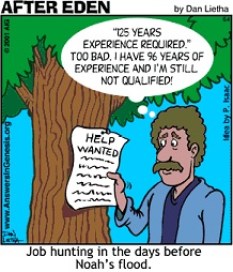
When I read about the number of years some of our forefathers lived, I cannot fathom what life would have been like living so many years. Could you imagine feeling this way in this single-panel comic?

On the positive side, I thought, we’d be really good at developing some of our skillsets. Could you imagine playing basketball for 438 years of your life? You’d be really good. But on the flip side, could you imagine working for another 438 years at your job? Even if you love your job, you’re probably saying to yourself, “No thank you.”

Well, either way, you won’t have to work for another 438 years. Nor do you get to refine your skills for that long. And I won’t have to figure out how my wife and I will celebrate our 438th anniversary, let alone our 20th (whew…), but for many of us, we still have a good number of years and decades ahead of us.

Job 14:5 tells us, “A person’s days are determined; you have decreed the number of his months and have set limits he cannot exceed.”

Whether it is 438 or 38, we all have a limited number of days on earth. Given that perspective, the big question is, “How then will we live this One.Life we get to live before our time expires?” In other words, what dream will you chase with your One.Life?

In a book I recently read titled, One.Life Jesus Calls, We Follow, the writer, Scot Mcknight, proposes: “Religion isn’t enough. Climbing the corporate ladder isn’t enough. Solving intellectual problems isn’t enough. Chasing the American dream isn’t enough. Finding the person to love isn’t enough. Sex isn’t enough. Friends aren’t enough. Science isn’t enough. Politics isn’t enough. Money isn’t enough. Food and drink aren’t enough. Fame isn’t enough. Nothing’s enough. The only thing that is enough is Jesus, and the only way to get to Jesus is to follow him, and that means one thing: giving your One.Life to him and to his dream.”

I truly believe if we are living that sort of life of following Jesus, 438 years might not seem that bad after all. None of us will get to 438. But given the One.Life that we have, let’s not waste it on anything else but following Jesus.

Prayer: Lord, You have numbered my days. Help me to live today and everyday that follows, following You, Jesus. I don’t want to follow anything or anyone else, but You and You alone. In Jesus’ name. Amen.

Bible Reading for Today: Acts 4-5

October 13, Friday

The AMI QT Devotionals from October 9-15 are provided by Pastor Peter Yoon of Kairos Christian Church in San Diego.  Peter is a graduate of U.C. Riverside and Talbot School of Theology (M.Div.).  He and his wife Jessica have three very active children: Nathan, Abigail, and Jason.

Devotional Thoughts for Today

“God Uses Ordinary People in Extraordinary Ways”

Genesis 12:10-13

Now there was a famine in the land, and Abram went down to Egypt to live there for a while because the famine was severe. 11 As he was about to enter Egypt, he said to his wife Sarai, “I know what a beautiful woman you are. 12 When the Egyptians see you, they will say, ‘This is his wife.’ Then they will kill me but will let you live. 13 Say you are my sister, so that I will be treated well for your sake and my life will be spared because of you.”

We understand that faith plays a critical role in our Christian life. Faith is critical for our salvation. Faith moves mountains. Faith heals people. In fact, without faith, we know it is impossible to please God (Heb. 11:6). But if we are honest, we often struggle with doubts. Many in the church wonder if they are genuinely saved. Mountains still remain while healings are sparse. It’s easy to scrutinize ourselves and have a low view of our own faith.

As a kid growing up in the church, I remember singing, “Father Abraham Had Many Sons.” Do you remember that song? (You can google it if you want to hear it.) It was a silly song with even sillier calisthenics, but I remember one time asking my Sunday School teacher, “Who the heck is Father Abraham?” Usually, we are told that he was a great man of great faith. He was called by God to leave his family, and he did. He was asked by God to sacrifice his son, and he almost did. He would receive a promise that his descendants would outnumber the stars in the sky. But they never told you that he lied about his wife…TWICE.

Here, we read the first time where Abraham lies to Pharaoh about his wife because he is afraid (the second time is found in Genesis 20). Both stories reveal a faithless man filled with self- preserving fears. I’m sure that Sarah didn’t appreciate being called Abraham’s sister, just so her husband can save his own hide. But that was who Abraham was. Now go ahead a google “father of faith” on your phone or laptop, and guess who comes up. You probably already guessed it, but it’s no one other than Abraham himself. NT passages such as Romans 4:16 (father to us all) and Hebrews 11:8-9 (by faith he made his home in the Promised Land) lead us to Abraham’s moniker, the “father of faith.”

That’s what God does. He takes people, such as Abraham, filled with doubts and fears, and simply asks us to follow Him. He already knows that we are filled with fears and reservations. I’m sure it wasn’t a surprise to God that Abraham used his wife. Yet, God simply asked Abraham to follow Him. Generations later, despite these humiliating stories, Abraham would be called the “father of faith.” When we follow Him and His ways, our fears make room for faith. One of many subplots of the Bible story is that God takes ordinary people and uses them for accomplishing His extraordinary purposes. He’s been doing that for thousands of years, and He’s still doing that today. How about allowing God to write that story in your own life?

Prayer: Lord, I admit that I’m far from having great faith. Help me in overcoming my own unbelief. Continue to work in and through me for accomplishing Your Kingdom purposes here on earth. In Jesus’ name. Amen.

Bible Reading for Today: Acts 3


Lunch Break Study

Read Mark 9:17-29 (NIV): A man in the crowd answered, “Teacher, I brought you my son, who is possessed by a spirit that has robbed him of speech. 18 Whenever it seizes him, it throws him to the ground. He foams at the mouth, gnashes his teeth and becomes rigid. I asked your disciples to drive out the spirit, but they could not.” 19 “You unbelieving generation,” Jesus replied, “how long shall I stay with you? How long shall I put up with you? Bring the boy to me.” 20 So they brought him. When the spirit saw Jesus, it immediately threw the boy into a convulsion. He fell to the ground and rolled around, foaming at the mouth. 21 Jesus asked the boy’s father, “How long has he been like this?” “From childhood,” he answered. 22 “It has often thrown him into fire or water to kill him. But if you can do anything, take pity on us and help us.” 23 “‘If you can’?” said Jesus. “Everything is possible for one who believes.” 24 Immediately the boy’s father exclaimed, “I do believe; help me overcome my unbelief!” 25 When Jesus saw that a crowd was running to the scene, he rebuked the impure spirit. “You deaf and mute spirit,” he said, “I command you, come out of him and never enter him again.” 26 The spirit shrieked, convulsed him violently and came out. The boy looked so much like a corpse that many said, “He’s dead.” 27 But Jesus took him by the hand and lifted him to his feet, and he stood up. 28 After Jesus had gone indoors, his disciples asked him privately, “Why couldn’t we drive it out?” 29 He replied, “This kind can come out only by prayer.”

Questions to Consider

  1. How does Jesus amaze you in this story?
  2. As you read through the father’s plea, “I do believe; help me overcome my unbelief,” how does that encourage you in your own place of faith and doubts?
  3. Jesus answers the disciples, “This kind can come out only by prayer.” Do you see a correlation between faith and prayer?

Notes

  1. Consider the severity of the boy’s condition, his duration, and the lack of faith by those around him. Yet, Jesus’ authority and power brings light into darkness. Is there anything that Jesus cannot do?
  2. There is such sincerity in the father’s plea to Jesus. He is neither presumptuous about his faith nor deeply insecure.
  3. Prayer by definition is dependence on God.

Evening Reflection

Spend a little extra time tonight in prayer, cultivating a greater dependence on the Lord.

October 12, Thursday

The AMI QT Devotionals from October 9-15 are provided by Pastor Peter Yoon of Kairos Christian Church in San Diego.  Peter is a graduate of U.C. Riverside and Talbot School of Theology (M.Div.).  He and his wife Jessica have three very active children: Nathan, Abigail, and Jason.

Devotional Thoughts for Today

“The Joy of Following Jesus”

Genesis 12:1

The LORD had said to Abram, “Go from your country, your people and your father’s household to the land I will show you.”

Years ago, Jessica and I were ministering at a retreat, and we sensed that some of the people present wanted to get closer to the Lord; yet, they were hesitating. It was there that I identified one of the reasons why believers hesitate to follow Jesus fully (with one foot on the brake): They have this notion that should they wholeheartedly commit to Jesus, God will immediately send them packing as missionaries to the “ends of the earth,” where they will suffer miserably under harsh conditions.

C.S. Lewis described his own conversion with the admission that he was “the most dejected and reluctant convert in all England” as God would demand everything from Lewis that had ever given him pleasures in life.

Genesis 12 begins a new chapter in the story of the Bible, a story of God’s redemption. God chooses Abram to build a nation, and through Israel, God would bring His Kingdom on earth. And it begins with the calling of Abram and Sarai to leave their country, people, and family. I assume that for Abram and Sarai, their relatives and their living circumstances were sources of comfort and happiness; yet, they would leave trusting in God’s promises.

Do you find yourself hesitating in your commitment to the Lord believing that He might take something away from you? Do you have a view of God that He’s out to lead you towards a life that is hard and without happiness?

Well, C.S. Lewis, as well as many others, have discovered that following Jesus have resulted in the very opposite to their assumptions. In fact, as Lewis followed Jesus, he was quite surprised by joy that was deeper than any momentary pleasures (Surprised by Joy). He discovered that true joy only results in knowing a Person and being devoted to Him.

May the Lord help all of us who still hesitate in following Him fully.

Prayer: Lord, I admit that I hesitate in my devotion to You because I’m afraid You might take things away from me. Help me to truly understand the love of the Father and the joy of following You. In Jesus’ name. Amen.

Bible Reading for Today: Acts 2


Lunch Break Study

Read Heb. 12:1-3 (NIV): Therefore, since we are surrounded by such a great cloud of witnesses, let us throw off everything that hinders and the sin that so easily entangles. And let us run with perseverance the race marked out for us, 2 fixing our eyes on Jesus, the pioneer and perfecter of faith. For the joy set before him he endured the cross, scorning its shame, and sat down at the right hand of the throne of God. 3 Consider him who endured such opposition from sinners, so that you will not grow weary and lose heart.

Questions to Consider

  1. How does the writer of Hebrews instruct the believers to continue in their faith?
  2. What motivated Jesus to endure the pain and suffering of the cross?

Notes

  1. He exhorts the believers to: throw off things that hinder us; to run the raced marked for us; to fix our eyes on Jesus; and to consider Christ who endured opposition.
  2. It was “for the joy set before him.” In other words, true joy awaited Him on the other side of the cross.

Evening Reflection

Ask the Holy Spirit to help you throw off sins that so easily entangle you, so that you can continue to run the race marked for you and discover true joy that is found in Christ Jesus.

October 11, Wednesday

The AMI QT Devotionals from October 9-15 are provided by Pastor Peter Yoon of Kairos Christian Church in San Diego.  Peter is a graduate of U.C. Riverside and Talbot School of Theology (M.Div.).  He and his wife Jessica have three very active children: Nathan, Abigail, and Jason.

Devotional Thoughts for Today

No Longer Confused

Genesis 11:7-9

Come, let us go down and confuse their language so they will not understand each other.” 8 So the LORD scattered them from there over all the earth, and they stopped building the city. 9 That is why it was called Babel—because there the LORD confused the language of the whole world. From there the LORD scattered them over the face of the whole earth.

One afternoon, I took my son, Nathan, to H-Mart, a local Korean grocery store. At the check-out line, I spoke to the cashier in Korean. My son looked stunned that a foreign language was coming out of my mouth. With confusion in his eyes, he said, “I didn’t know you can speak Spanish.” I had a good laugh sharing that story with my wife later that evening. However, when confusion is a result of misinterpretations and misunderstandings, it is quite frustrating. Even when speaking the same language with one another, how often our miscommunications and misunderstandings have impeded a project, or worse, wrecked a relationship?

Well, we can “thank” those who attempted to build a tower thousands of years ago in their attempts to become gods themselves. That contemptible effort only resulted in God’s judgment of confusing their language, thereby making it impossible for them to work together. But confusion, segregation, and frustration was never God’s intended plan; in fact, God made Eve because it was not good for man to be alone. God’s plan for His children was for them to enjoy harmonious relationships based on clear communication, genuine intimacy, and strong unity.

Thousands of years later, the pattern of confusion and segregation finally got reversed when Christ inaugurated the Kingdom of God (Mt. 12:28). Later, as the Holy Spirit came upon all the believers—irrespective of their gender, age or economic standing—at Pentecost, we see the reversal of effect of the Tower of Babel. There in Jerusalem, God enabled people who had come speaking different languages to hear the good news of God’s kingdom in their own language. Subsequently, the believers began to live in a new kind of community that once again reflected intimacy and unity. The language barrier no longer divided as the Spirit of Jesus brought peace, thereby destroying “the dividing wall of hostility” (Eph. 2:14).

As our society increasingly becomes polarized over seemingly endless hot-button issues, our words and/or actions based on biblical conviction can often be misunderstood by those on the other side who then respond with sharp criticism and accusation. This is all the more reason why we should hold fast to the Spirit of Christ so that the Body of Christ continues to break down walls of hostility rather than erecting new barriers.

Prayer: Lord, give us unity in our churches. Help us to forgive; help us to be generous; help us to submit to one another; help us to live in the peace of our Lord Jesus Christ. In Jesus name,
Amen.

Bible Reading for Today: Acts 1


Lunch Break Study

Read Acts 1:6-8 (NIV): Then they gathered around him and asked him, “Lord, are you at this time going to restore the kingdom to Israel?” 7 He said to them: “It is not for you to know the times or dates the Father has set by his own authority. 8 But you will receive power when the Holy Spirit comes on you; and you will be my witnesses in Jerusalem, and in all Judea and Samaria, and to the ends of the earth.”

Questions to Consider

  1. What does the question raised by the disciples reveal about their understanding of God’s Kingdom?
  2. According to this passage, why is it important for the disciples to receive power?
  3. Read the prayer of Jesus in John 17:23 – “I in them and you in me—so that they may be brought to complete unity. Then the world will know that you sent me and have loved them even as you have loved me.” Do you see any connection between the power of the Holy Spirit and the unity of the disciples?

Notes

  1. The disciples still had a limited understanding of the Kingdom of God; they still thought that the nation of Israel would soon rule over Rome and other nations. However, God’s Kingdom (spiritual) would arrive on earth through the Spirit of God.
  2. We see that power is necessary for the believers to serve as witnesses of the good news of Jesus.
  3. The result of power and unity is salvation of unbeliever. The “power” of the Holy Spirit is often exclusively associated with sign gifts such as healing and prophecy; however, it is also necessary for the disciples to preserve the unity of peace because, without it, the world cannot tell them apart from unbelievers. When the world sees a genuine Christian unity, this makes the gospel that much attractive for unbelievers.

Evening Reflection

Ask the Lord to mend a broken relationship that might be affecting you, especially as it pertains to your family or your church (e.g., pastors, small group leaders, etc.).

October 10, Tuesday

The AMI QT Devotionals from October 9-15 are provided by Pastor Peter Yoon of Kairos Christian Church in San Diego.  Peter is a graduate of U.C. Riverside and Talbot School of Theology (M.Div.).  He and his wife Jessica have three very active children: Nathan, Abigail, and Jason.

Devotional Thoughts for Today

“Building in Vain”

Genesis 11:4

Then they said, “Come, let us build ourselves a city, with a tower that reaches to the heavens, so that we may make a name for ourselves; otherwise we will be scattered over the face of the whole earth.”

Do you know the nickname of the city where you live? Mine is named, “America’s finest city.” If you don’t know your city’s nickname, perhaps you can find it here: https://en.wikipedia.org/wiki/List_of_city_nicknames_in_the_United_States.

Many cities in the US are given nicknames that reveal their civic identities. These nicknames can sometimes provide a sense of community for its residents as well as a sense of civic pride. I do sense a bit of pride about my city having its nickname. Does your city’s nickname give you a sense of pride?

Well, the ancient people also wanted a city with a proud nickname. They congregated together and said to themselves, “Come, let us build ourselves a city, with a tower that reaches to the heavens.” The ancient people actually believed that heavens were not too far above the earth. They believed that if only they could build a tower to the sky, they would be allowed to climb up and be like gods themselves.

The story of the Tower of Babel is unfortunately another story of man’s rebellion against the Creator. The story shows an obvious difference between the human opinion of self-achievement versus God’s viewpoint of such activities. In God’s perspective, all human cooperation when it is fueled by autonomy and directed towards self-interest is shallow and impotent. (Mathews, NAC: Genesis)

That can also be said of our lives. We might choose to live a life of autonomy from our God aimed at promoting our name, but it is precisely this life that comes to a crashing devastation. Jesus once asked: “What good will it be for someone to gain the whole world, yet forfeit their soul? Or what can anyone give in exchange for their soul?”

Is the life you’ve been given one that is lived in autonomy, or is it lived in an on-going dependence on God? Can a person close to you observe your life and know that you live for God or live for yourself?

If you were a city, what would be your nickname?

Prayer: Lord, I depend on Your Spirit to fill me and guide me today. I ask you even for my “daily bread” knowing that You are my Provider. Help me to live a life that glorifies and magnifies Your name more than any other name on earth. In Jesus’ name. Amen.

Bible Reading for Today: Isaiah 66


Lunch Break Study

Psalm 127:1-2 (NIV)
Unless the LORD builds the house,
    the builders labor in vain.
Unless the LORD watches over the city,
    the guards stand watch in vain.
2  In vain you rise early and stay up late,
toiling for food to eat—
    for he grants sleep to those he loves.

Questions to Consider

  1. Think about the phrase “in vain,” which is repeatedly used in these passages. Why does the psalmist come to this conclusion that unless the Lord is involved, your efforts end “in vain”?
  2. Substitute the word “house” with “family.” In what ways is the Lord building your family? Or substitute the word “city” with “children.” In what ways do you ask the Lord to stand watch over your children?

Notes

  1. All help, all protection, and all blessing come from God; without Him all labor, care, and trouble are vain.
  2. In providing care for children as parents, it is easy to assume that we know what’s best or that we are in control. While it is important to care and provide for our children, the Lord directs us to teach His commands to our children as the most important work as parents.

Evening Reflection

What area of your life still remains autonomous from the Lord? Consider how you can yield that area of your life to the Lord.

October 9, Monday

The AMI QT Devotionals from October 9-15 are provided by Pastor Peter Yoon of Kairos Christian Church in San Diego.  Peter is a graduate of U.C. Riverside and Talbot School of Theology (M.Div.).  He and his wife Jessica have three very active children: Nathan, Abigail, and Jason.

Devotional Thoughts for Today

Jude 3-4

Dear friends, although I was very eager to write to you about the salvation we share, I felt compelled to write and urge you to contend for the faith that was once for all entrusted to God’s holy people. 4 For certain individuals whose condemnation was written about long ago have secretly slipped in among you. They are ungodly people, who pervert the grace of our God into a license for immorality and deny Jesus Christ our only Sovereign and Lord.

Churches are filled with many young impressionable believers that can make discipleship exciting. However, at times, it’s unfortunate when someone in the church twists God’s grace into a license to sin. It is true that no person is required to observe the OT Law as a means for salvation; the gospel of Jesus Christ is that Heaven is absolutely a free gift; and no church attendance or offering money is at all required for salvation. This is because when Jesus died on the cross, He fulfilled the OT Law (Rom. 10:4; Gal. 3:23-25). However, the unbiblical conclusion is that there’s nothing that God expects of Christians in terms of a disciplined life in God’s Spirit, and some begin to think, “If I’m saved by grace and all of my sins, past, present, and future, are forgiven, why not sin all I want?”

Do you at times hold to that line of thinking? After many failed attempts to live a holy life, we develop a calloused “so-what” attitude towards sin.  However, that thinking is not the fruit of a genuine relationship with God. God’s desire is that we become increasingly more like His Son. Though we can’t do it on our own, God’s grace and His Spirit helps us in our weaknesses as we strive towards holiness. Since God has given us His precious gift of salvation through Jesus, our response is to obey Him out of love and gratitude for what He has done for us (Rom. 12:1-2).

Are there areas in your life where you are twisting the idea of God’s grace?

Prayer: Lord, your grace is truly precious. Thank you that you required nothing from me in receiving your salvation. But now that I’ve been saved, teach me daily to give you everything in living for your purposes. Amen.

Bible Reading for Today: Isaiah 65


Lunch Break Study

Read Matt. 13:24-30; 36-43: Jesus told them another parable: “The kingdom of heaven is like a man who sowed good seed in his field. 25 But while everyone was sleeping, his enemy came and sowed weeds among the wheat, and went away. 26 When the wheat sprouted and formed heads, then the weeds also appeared. 27 “The owner’s servants came to him and said, ‘Sir, didn’t you sow good seed in your field? Where then did the weeds come from?’ 28 “‘An enemy did this,’ he replied. “The servants asked him, ‘Do you want us to go and pull them up?’ 29 “‘No,’ he answered, ‘because while you are pulling the weeds, you may uproot the wheat with them.30 Let both grow together until the harvest. At that time I will tell the harvesters: First collect the weeds and tie them in bundles to be burned; then gather the wheat and bring it into my barn.’”  36 Then he left the crowd and went into the house. His disciples came to him and said, “Explain to us the parable of the weeds in the field.” 37 He answered, “The one who sowed the good seed is the Son of Man. 38 The field is the world, and the good seed stands for the people of the kingdom. The weeds are the people of the evil one, 39 and the enemy who sows them is the devil. The harvest is the end of the age, and the harvesters are angels. 40 “As the weeds are pulled up and burned in the fire, so it will be at the end of the age. 41 The Son of Man will send out his angels, and they will weed out of his kingdom everything that causes sin and all who do evil. 42 They will throw them into the blazing furnace, where there will be weeping and gnashing of teeth. 43 Then the righteous will shine like the sun in the kingdom of their Father. Whoever has ears, let them hear.

Questions to Consider

  1. At the end of the age, all of the weeds will be pulled up and burned in the fire. However, at this present age, what does Jesus say about the weeds?
  2. Why does owner allow the weeds to remain along with the wheat?
  3. This parable does not teach toleration of illegitimate doctrines in the church. However, at the present age, the church will be faced with ungodly people who attempt to pervert God’s grace. How can you keep yourself from being deceived by ungodly thinking?

Notes

  1. Jesus explains that God tolerates the wicked in the present for the sake of his elect, but will publicly distinguish between the two in the day when the secrets of the kingdom are revealed. God endures the wicked in the present to provide all those who will receive him time to become his followers (Rom. 9:22-24; 2 Pet. 3:9, 15).
  2. Jesus’ primary point is the coexistence of kingdom people with the world’s people in this age. The point here is NOT that we should abandon our efforts to keep the church pure (18:7-14, 21-35); rather, the kingdom remains obscure in the present world and only the final day will bring God’s true children into their vindicated glory and banish the wicked from among them.
  3. Personal response

Evening Reflection

Prayer: Lord, I confess that in my sinfulness, I can be great at selective hearing when it comes to the Word of God. Help me to humble myself before the entire counsel of Scripture. Empower me with Your Spirit to agree with Your Word in the areas that are difficult for me to obey. Amen.