November 25, Sunday

Devotional Thought for Today

“It Must Be Faith with Deeds”

James 2:14-26

What good is it, my brothers and sisters, if someone claims to have faith but has no deeds? Can such faith save them? 15 Suppose a brother or a sister is without clothes and daily food. 16 If one of you says to them, “Go in peace; keep warm and well fed,” but does nothing about their physical needs, what good is it? 17 In the same way, faith by itself, if it is not accompanied by action, is dead. 18 But someone will say, “You have faith; I have deeds.” Show me your faith without deeds, and I will show you my faith by my deeds. 19 You believe that there is one God. Good! Even the demons believe that—and shudder. 20 You foolish person, do you want evidence that faith without deeds is useless? 21 Was not our father Abraham considered righteous for what he did when he offered his son Isaac on the altar? 22 You see that his faith and his actions were working together, and his faith was made complete by what he did. 23 And the scripture was fulfilled that says, “Abraham believed God, and it was credited to him as righteousness,” and he was called God’s friend. 24 You see that a person is considered righteous by what they do and not by faith alone. 25 In the same way, was not even Rahab the prostitute considered righteous for what she did when she gave lodging to the spies and sent them off in a different direction? 26 As the body without the spirit is dead, so faith without deeds is dead.

When I decided to go on one-year missions to Shanghai in 2013, I shared the news with faith workmy non-Christian brother. His immediate response to what was supposed to be an exciting news was, “Don’t you think it’s better to provide education and service to people in need than organized religion?” Although his response hurt and frustrated me, I realize now that his question has some merit. What can religion do for the one who is sick, starving or without any basic needs met? Of course, they may be able to have a relationship with God and go to heaven, but is that what Christianity is all about? Does the God of love only care about salvation and not the earthly needs of His children?

When we look at the Bible, we can see that God is not reticent of people’s needs. Instead, we see God’s providential hand all throughout Israel’s journey from slavery into the promised land; we see Jesus’ heart to heal the brokenhearted in the story of Samaritan women; and we see Jesus feeding people rather than sending them away. Luke 4:18 sums up Jesus’ ministry as more than a proclamation of spiritual salvation, but a holistic ministry that brings deliverance to the captives, healing to the sick, and release for the oppressed.

The Christian faith is one that goes beyond a belief in Jesus Christ as Lord and Savior. It is a faith that is put to the test by our actions where faith and deeds meet to reflect the life of Christ. James calls it foolish to believe that you can have one without the other; in fact, Satan even believes in God, yet his faith is not credited to him as righteousness because his actions (or lack thereof) do not reflect a true salvific faith.

It is no different with us. To live an active life of faith we are called to respond with our deeds. While the greatest moment in our relationship with God is when we come to faith in the life, death, and resurrection of Jesus Christ who saves a sinner like us, James shows us that our faith is made complete by our actions. That is, we are called to more than a life of belief, but a life where all that we do reflects the hope and faith that we have in a God who cares about all the needs of a person – physical, emotional, mental, and spiritual. Therefore, let us be people whose faith is made complete by our faith and actions today!

Prayer: God I thank You that your work on the cross has sanctified me once and for all. Help me to live a life of not just faith, but a life with faith and deeds. And help me to be a beacon of light to others in all of their needs. In Jesus name. Amen.

Bible Reading for Today: Ecclesiastes 6

November 24, Saturday

Devotional Thoughts for Today

“Favoritism Forbidden”

James 2:1-9

My brothers and sisters, believers in our glorious Lord Jesus Christ must not show favoritism. 2 Suppose a man comes into your meeting wearing a gold ring and fine clothes, and a poor man in filthy old clothes also comes in. 3 If you show special attention to the man wearing fine clothes and say, “Here’s a good seat for you,” but say to the poor man, “You stand there” or “Sit on the floor by my feet,” 4 have you not discriminated among yourselves and become judges with evil thoughts? 5 Listen, my dear brothers and sisters: Has not God chosen those who are poor in the eyes of the world to be rich in faith and to inherit the kingdom he promised those who love him? 6 But you have dishonored the poor. Is it not the rich who are exploiting you? Are they not the ones who are dragging you into court? 7 Are they not the ones who are blaspheming the noble name of him to whom you belong? 8 If you really keep the royal law found in Scripture, “Love your neighbor as yourself,” you are doing right. 9 But if you show favoritism, you sin and are convicted by the law as lawbreakers. 

I distinctly remember my 1st grade teacher who would give out “special assignments” to her students. These assignments were small tasks such as delivering papers to teachers or retrieving mails from the office. Why it was special, I’m not quite sure anymore since it was simply running errands for the teacher; but it was an excuse to get out of the classroom with a “buddy” of your choosing. In the beginning of the year, I would raise my hand expectantly, but every time I found myself putting my hand down discouraged. It didn’t take me long, however, to realize that my teacher would always pick the same girl, and that girl would always pick the same friend! My teacher had a favorite whom she picked every single time, and that student had a favorite whom she picked every time. It was no secret to anybody in the class, and this left every student feeling like they were loved less than our teacher’s favorite.

Today’s verse begins with a call to all Christians to live a life without favoritism. James, first, notes the obvious: It is easier to pay more attention to the one who is rich than the one who is poor.  James, then, radically reframes our perspective by pointing out that God did not show favoritism with us; instead, God chose sinners like us to be rich in faith that we may inherit the Kingdom of God forever. While we were broken and rejected, “He lifted [us] up from the pit of destruction, out of the miry clay; He set [our] feet upon a rock, and made [our] footsteps firm” (Ps 40:2). When we recognize we are recipients of this amazing love and grace, our response should be to love all our neighbors without partiality as well.

The favoritism James has in mind may be extended to the kinds that seep into all areas of life. We see favoritism in the workplace when the colleagues who have more degrees getting the choice assignments; in schools with the kids from affluent homes having more friends; in the church with the people who are more gifted getting all the attention; and in politics with those who belong to a particular race getting preferential treatments.  Favoritism can be as seemingly insignificant as school labels to as big as racism, but as James reveals that partiality is an active rebellion against God’s commands to love others as ourselves.

Let’s take some time today to reflect on the various ways that we may have engaged in favoritism. As we go in repentance for the ways that we may have failed to love others the way God loves us, let us be reminded that God did not discriminate against us but brought us into a life of faith.  

Prayer: God I thank You for your love that brought me out of the miry clay to be set upon a rock. I ask for Your forgiveness in the ways I have participated in favoritism. Help me to love all my neighbors as myself without partiality. In Jesus name. Amen

Bible Reading for Today: Ecclesiastes 4-5

November 23, Friday

Devotional Thoughts for Today

“Look After the Distressed”

James 1:26-27

 Those who consider themselves religious and yet do not keep a tight rein on their tongues deceive themselves, and their religion is worthless. 27 Religion that God our Father accepts as pure and faultless is this: to look after orphans and widows in their distress and to keep oneself from being polluted by the world.

For many families the Thanksgiving tradition goes far beyond a traditional turkey meal with family members gathering from all over town to express their gratitude. Instead, Thanksgiving means getting past the turkey food coma to wait in line to snag the best Black Friday deals. It’s estimated that in 2016, 101.7 million people braved the crowds to grab their long-awaited discounts. It’s always puzzling to me to that the busiest shopping day would be after a holiday designated for gratitude and family gatherings. Every year I hear stories on the news about lines circling around buildings, people getting trampled on, and fights being broken up at the wee hours of the night. It’s as if Thanksgiving did not happen a few hours before as people fight for material possessions, pushing anyone aside to get their bargains.

Today’s passage talks about a religion that our Father accepts as pure as one that looks after the marginalized. We see that on the top of God’s priority is for His children to take care of those in need. While it may be easy to dismiss the problem of homelessness, hunger, and poverty as a problem too big for us to solve, God highlights throughout Scripture our call to bring, not only spiritual revival for others, but physical as well. We are called to be the light of the world in every situation by serving God’s children in all areas of need.

In America, while 101 million people wait in lines during Black Friday every year, about 40 million people face hunger every day. If every person who goes shopping on Friday serves one person who may not have the opportunity to enjoy a holiday meal, we could provide a Thanksgiving meal for two years. While I am not saying discount shopping is bad, let’s remember that God calls us to look after those in need.

Can I encourage you this Black Friday to continue in a heart of gratitude by serving someone who may be in need it? It can be as simple as blessing a retailer worker who missed Thanksgiving to work, donating to a local food pantry, or using the money you saved for Black Friday shopping on someone in need. Whatever it is, may we, in Thanksgiving, be a light to those who are in need.

Prayer: God I thank You for Your constant provision in my life. Help me to be a light to those who need it most this season. May I be able to inconvenience myself to serve those who may be less fortunate. In Jesus name. Amen.

Bible Reading for Today: Ecclesiastes 3


Lunch Break Study

Read Philippians 2:5-8: In your relationships with one another, have the same mindset as Christ Jesus: 6 Who, being in very nature God, did not consider equality with God something to be used to his own advantage; 7 rather, he made himself nothing by taking the very nature of a servant, being made in human likeness. 8 And being found in appearance as a man, he humbled himself by becoming obedient to death—even death on a cross!

Questions to Consider

  1. What attitude should we have while serving others?
  2. How did Jesus model the attitude of service we should have?
  3. List some practical ways that you can serve someone today.

Notes

  1. We should have an attitude of humility, like Jesus.
  2. Jesus modeled a life of humility and service by coming into the world to face death for the sins of the world.
  3. Personal response.

Evening Reflection

This morning we discussed a religion that God deems pure and faultless as one that looks after the marginalized. We reviewed in the afternoon, Jesus’s life as the greatest testimony of service to the marginalized when he faced death on the cross for sinners. How did you do in being a humble servant today? Were you able to help someone in need, pray for someone who may be struggling, or give what you have to those less fortunate? Tomorrow is a new day, but remember Christianity is called to be a religion that helps those in need.

November 22, Thursday

Devotional Thoughts for Today

–Wishing a Blessed Thanksgiving to All Our Readers–

“Greater Are His Ways”

James 1:22-25

Do not merely listen to the word, and so deceive yourselves. Do what it says. 23 Anyone who listens to the word but does not do what it says is like someone who looks at his face in a mirror 24 and, after looking at himself, goes away and immediately forgets what he looks like. 25 But whoever looks intently into the perfect law that gives freedom, and continues in it—not forgetting what they have heard, but doing it—they will be blessed in what they do.

Today’s passage is one that I used to hear every youth pastor speak on, yet I always had mirrordifficulty understanding it as a young believer. I didn’t necessarily have trouble understanding the meaning of the passage, but I couldn’t seem to understand the analogy associated with the verse. I mean how ridiculous is it for any person to forget what they look like after staring at the mirror. Isn’t the very point of staring at a mirror to see what you look like? It would take me a long time to realize that the absurdity of the analogy was precisely why it was used in this context. In the same way it is ridiculous for any person to forget what they look like after staring at an object for the sole purpose of looking at themselves, it is foolish for a person to stare at a Bible and walk away with the heart of disobedience. Why read the Word then?

Today’s passage highlights the truth that we are called to read the Word with the heart to obey. Anything other than a desire towards obedience to the Word is deception in James’s eyes, and as absurd as forgetting how you look like while staring at a mirror. But more than that, we read that obedience to the will of God is what leads to true blessings. So often we believe our ways are better than God’s way because we want to see our own type of fruit, but James shows us that true blessing comes in walking in alignment with the Father.

Stickered on the front page of my Bible is a post-it that says, “If we read with the will to obey, He by His Spirit will show us His way.” Let us be people who open our Bibles every day, not just for the sake of reading the Word, but with the will to obey. When we come with this heart of obedience it is God’s promise that He will show us a way to submit to His will. Take some time now to reflect on any areas of your life that you are struggling to obey God. Be encouraged by today’s passage that it is in the perfect law that there is freedom, and thus, you can release your plans for His as God’s desire is to bring blessings upon your life.

Prayer: God I thank you for Your saving grace that has made me a new creation. Help me to read the Word every day with the heart of obedience. I pray that You would make a way in times when my heart desires to go astray. In Jesus name. Amen.

Bible Reading for Today: Ecclesiastes 2


Lunch Break Study:

Read Psalm 19:7-11: The law of the Lord is perfect, reviving the soul; the testimony of the Lord is sure, making wise the simple; 8 the precepts of the Lord are right, rejoicing the heart; the commandment of the Lord is pure, enlightening the eyes; 9 the fear of the Lord is clean, enduring forever; the rules of the Lord are true, and righteous altogether. 10 More to be desired are they than gold, even much fine gold; sweeter also than honey and drippings of the honeycomb. 11 Moreover, by them is your servant warned; in keeping them there is great reward.

Questions to Consider

  1. What does this passage say about the commandment of the Lord (i.e., descriptors)
  2. What does this passage list as the benefits of keeping God’s commandments?
  3. Take some time to reflect on ways you can obey the Lord today. It can be as simple as taking the time to pray for your neighbors or maybe it’s something God has been asking you to do for a while, but you have been hesitant to obey. May you find that the Word is sweater than honey as you obey His call.

Notes

  1. The law is perfect, right, pure, clean, true, righteous, precious, and sweet.
  2. The law will revive one’s soul, rejoice one’s heart, and enlighten one’s eyes.
  3. Personal response.

Today we discussed our call to not only read the Word but to obey His Word. So how did you do? Were you able to read the Word with the will to obey? If you are struggling with obedience in a particular area can I encourage you to share with a trusted friend. Some of the greatest breakthroughs come in vulnerability and prayer, and it may just be the encouragement you need. Tomorrow is a new day, may your prayer be that you would begin each day with a heart of obedience to the King!

November 21, Wednesday

Devotional Thoughts for Today

“Greater Are His Ways”

James 1:19-21

My dear brothers and sisters, take note of this: Everyone should be quick to listen, slow to speak and slow to become angry, 20 because human anger does not produce the righteousness that God desires. 21 Therefore, get rid of all moral filth and the evil that is so prevalent and humbly accept the word planted in you, which can save you.

(To continue yesterday’s story) After my running accident, I was told I needed surgery. Devastated—knowing that I did not have the money to pay for the surgery—I shared with a church sister in tears. About a week later, I received a text that this sister had made arrangements for me to attend a healing conference in Georgia. Humbled and overwhelmed, I flew to Georgia with so much confidence that God would heal me. Every passing day I waited for God to do what seemed like the impossible, but every day nothing changed. I left Georgia still in pain and distraught that nothing had changed. But a week after I arrived home, something was radically different in me. That is, it took me about a week to realize God had healed me of my depression during the conference!

In our moments of trial, anger is usually the first emotion we feel. Anger was not only my first reaction during my accident, but it was my perpetual attitude after hearing I needed surgery. Today’s passage teaches us, however, that “human anger does not produce the righteousness that God desires” (v.20). How many times have we found ourselves in the wrong place for allowing our anger to get the best of us? In our anger we say things that hurt others, we blame God, and we act in full rebellion to God’s Word. But James calls us to righteousness by humbly accepting the Word planted in us (v.21). We are called to respond to every situation with the truths declared in Scripture. While human anger will always reap works of the flesh, the Word will always reap righteousness in our lives.

I went to this conference angry and hurting, wondering how I got to this point after a simple attempt to change my life. But God’s plan was always to bring healing and restoration in ways I did not expect. That is the promise in Scripture that God “knows the plan [He] has for you . . . plans to prosper you and not to harm you, plans to give you hope and a future” (Jer. 29:11). Whatever you are going through, may today’s passage be a reminder to look to the promises of Scripture instead of responding in human anger. His plans are always good, and we can trust and hope in His promises that never change.

Prayer: God I thank You that I can trust in every word You have declared. Help me to respond to all situations with humility and not in anger. Help me to be quick to listen, slow to speak, and slow to be angry. In Jesus name. Amen.

Bible Reading for Today: Ecclesiastes 1


Lunch Break Study

Read Titus 3:1-7: Remind the people to be subject to rulers and authorities, to be obedient, to be ready to do whatever is good, 2 to slander no one, to be peaceable and considerate, and always to be gentle toward everyone. 3 At one time we too were foolish, disobedient, deceived and enslaved by all kinds of passions and pleasures. We lived in malice and envy, being hated and hating one another. 4 But when the kindness and love of God our Savior appeared, 5 he saved us, not because of righteous things we had done, but because of his mercy. He saved us through the washing of rebirth and renewal by the Holy Spirit, 6 whom he poured out on us generously through Jesus Christ our Savior, 7 so that, having been justified by his grace, we might become heirs having the hope of eternal life.

Questions to Consider

  1. What reminder does this passage give to all Christians?   
  2. What does this passage say regarding what we used to do before God our Savior appeared?
  3. Why do you think the author reminds us of what Christ has done for us after telling how we should act as well as how we used to be before meeting Christ?

Notes

  1. The passage reminds us to be submit to authority, to be obedient, do what is good, slander no one, be peaceable and considerate, and gentle towards everyone.
  2. The passage reminds us we were foolish, disobedient, deceived and enslaved by all kinds of passion and pleasure, and we lived in malice, envy, and hatred.
  3. The conjunction “but” in verse 4 seems to imply that because God has saved us, we are saved from our old ways and we are able to act according to verses 1 to 2.

Evening Reflection

Today we looked at James’s call to respond in righteousness by the way of the Word in moments of trial. Although our natural response may be anger during times of difficulty, our lunch break passage reveals that because of Jesus’s work on the cross we can respond in obedience and gentleness. Take some time to reflect on the day and write down instances that you may have responded in your old nature. Go in repentance before the Lord, but do not be discouraged, for it is God’s work on the cross that will allow the Holy Spirit to help you overcome. Remember, you are a new creation and God’s mercies are new every morning.

November 20, Tuesday

Devotional Thoughts for Today

“The God of Every Good and Perfect Gift”

James 1:12-18

Blessed is the one who perseveres under trial because, having stood the test, that person will receive the crown of life that the Lord has promised to those who love him. 13 When tempted, no one should say, “God is tempting me.” For God cannot be tempted by evil, nor does he tempt anyone; 14 but each person is tempted when they are dragged away by their own evil desire and enticed. 15 Then, after desire has conceived, it gives birth to sin; and sin, when it is full-grown, gives birth to death. 16 Don’t be deceived, my dear brothers and sisters. 17 Every good and perfect gift is from above, coming down from the Father of the heavenly lights, who does not change like shifting shadows. 18 He chose to give us birth through the word of truth, that we might be a kind of first fruits of all he created.

Back in 2016, I fell into a deep state of depression that shook every foundation in my life. I had hit such a low point that I became adamant about changing every routine in my life just to see healing. One of those changes was running regularly. It was about three weeks into my new routine, however, when I went out for my run and I clumsily stepped hard into a ditch. I heard a pop in my hip and I was immediately on the floor in pain. (Later, I was diagnosed with a hip labral tear that would require surgery.) My honest thought at the moment was, “Really God?! I’m already in emotional pain. Now this!”

When trials come our way, one of the last things on our mind is to remain faithful and believe that at the end of it, we “will receive the crown of life” (v.12). Instead, we focus on our problems, we wonder why God would bring us pain, and we blame God, actively choosing sin as we try to make our own way. While exercising is not sin, I later realized that my decision to go running was my own; and in my distraction, I did not see the ditch that was right in front of me.

But today’s passage shows us that God does not tempt us, but we have a choice during our moments of trial to choose God or be tempted by sin. While it may be easier to be tempted by sin during our difficulties, we see that all sin leads to spiritual death, while our God offers every good and perfect gift. To receive the crown of life, we must choose every day and in every situation which master we will serve—God or sin.

There is more to this story (i.e., God’s healing) and I plan to share that tomorrow.  For now, remember that whatever you are going through in your life, may today’s passage be a reminder that every good and perfect gift is from above. God knows your pain, and your struggles are not in vain. Take heart for God has overcome to world, and He desires to lavish on you the crown of life!

Prayer: God, I thank You that every good and perfect gift is from You. Help me to see that in every trial and tribulation, that Your desire is not to harm me but to raise me up. Help me to choose You this day so that I may walk in faithfulness and away from sin. In Jesus’ name. Amen.

Bible Reading for Today: John 21


Lunch Break Study

Read Matthew 6:25-34: “Therefore I tell you, do not worry about your life, what you will eat or drink; or about your body, what you will wear. Is not life more than food, and the body more than clothes? 26 Look at the birds of the air; they do not sow or reap or store away in barns, and yet your heavenly Father feeds them. Are you not much more valuable than they? 27 Can any one of you by worrying add a single hour to your life? 28 “And why do you worry about clothes? See how the flowers of the field grow. They do not labor or spin. 29 Yet I tell you that not even Solomon in all his splendor was dressed like one of these. 30 If that is how God clothes the grass of the field, which is here today and tomorrow is thrown into the fire, will he not much more clothe you—you of little faith? 31 So do not worry, saying, ‘What shall we eat?’ or ‘What shall we drink?’ or ‘What shall we wear?’ 32 For the pagans run after all these things, and your heavenly Father knows that you need them. 33 But seek first his kingdom and his righteousness, and all these things will be given to you as well. 34 Therefore do not worry about tomorrow, for tomorrow will worry about itself. Each day has enough trouble of its own.

Questions to Consider

  1. Why does Jesus tell us not to worry?
  2. Who does Jesus associate worriers with?
  3. What are some of the things that worry you the most? Reflect on whether these worries come from desires that drive your life instead of faith in God.

Notes

  1. Because our Heavenly Father provides for all our needs.
  2. Jesus says that pagans worry about the needs of life, but as Christians, we are called to seek first His kingdom and His righteousness.
  3. Personal reflection.

Evening Reflection

This morning we reflected on our Heavenly Father who provides every good and perfect gift; and in the afternoon, we looked at Jesus’ call to Christians to seek first His Kingdom and His righteousness that it may go well with us.  The two are very much intertwined when we recognize that we are called to live a life of faith. Faith is what will allow us to endure trials, recognizing that it’s in our trials that God is doing a good work in us. And faith is what will allow us to recognize that God will provide for all of our needs. Take time to reflect on some areas that you are lacking faith, and ask God to fill you with hope and trust in this area. It is God’ desire that you would release the doubts, so that He may fill it with Truth. It all begins with a prayer of submission and release.

November 19, Monday

The AMI QT Devotionals from November 19-25 are provided by Jennifer Kim, a staff at Catalyst Agape Church (New Jersey). Jennifer, a graduate of Boston University, spent a year in Shanghai as one-year intern from 2013-14. She is currently attending Alliance Theological Seminary.


Devotional Thoughts for Today

“Finding Joy in Affliction”

James 1:1-11

James, a servant of God and of the Lord Jesus Christ, To the twelve tribes scattered among the nations: Greetings. 2 Consider it pure joy, my brothers and sisters, whenever you face trials of many kinds, 3 because you know that the testing of your faith produces perseverance .4 Let perseverance finish its work so that you may be mature and complete, not lacking anything. 5 If any of you lacks wisdom, you should ask God, who gives generously to all without finding fault, and it will be given to you. 6 But when you ask, you must believe and not doubt, because the one who doubts is like a wave of the sea, blown and tossed by the wind. 7 That person should not expect to receive anything from the Lord. 8 Such a person is double-minded and unstable in all they do. 9 Believers in humble circumstances ought to take pride in their high position.10 But the rich should take pride in their humiliation—since they will pass away like a wild flower. 11 For the sun rises with scorching heat and withers the plant; its blossom falls and its beauty is destroyed. In the same way, the rich will fade away even while they go about their business.

Hiking is one activity I dislike. It requires days of planning, heavy lifting, profuse amount of sweating, bugs, lack of water, etc. I have tried to be understanding by asking countless hikers what makes hiking so enjoyable for them. Nine out of 10 times they will say it’s about the accomplishment of getting to the top of the mountain, seeing the beautiful scenery, and knowing you made it after a long, gruesome process. Now I recognize that my lack of understanding for the world of hiking comes from my inability to reconcile the seeming paradox of how something so arduous can be so enjoyable.  I also recognize that this struggle is one that many Christians face when they read today’s passage.

How can any person consider it, not just joy, but PURE joy, when they face trials of, not just one kind, but MANY kinds? The answer is seemingly quite simple for James – by recognizing that trials produce a perseverance that matures our faith to be made complete, lacking absolutely nothing. Wow, a faith that lacks nothing! Imagine with me what a faith that lacks nothing looks like – no doubts, no fears, no bitterness, and no obstacles between you and God. This faith is not fleeting nor is it a momentary revelation, but it changes us completely to begin living in complete trust and faith in our God. As paradoxical as it may seem to be joyful when we are struggling, when we look at it in light of the fruit that trials can produce in our lives, we are able to see that every difficulty is worth the struggle in order that our faith may be made complete.

Ultimately, I may not be able to understand hiking because I cannot see the joy and glory of making it to the top of the mountain; but, I can certainly say that a faith that lacks nothing is worth every battle. If you are going through a difficult time, I pray that you would find peace and rest in your circumstances. I recognize that the call to be joyful in all trials is easier said than done. But can I encourage you to reframe your perspective to see that it is God’s love for you to grow in intimacy with Him that you may be facing trials. You are not alone as God’s hand is in your trials. May your faith be made complete through your circumstances.

Prayer: God I thank You that You love me too much to let me stay the same. I pray that you would grant me wisdom to see You in all circumstances that I may persevere in my trials and find true joy. Refine me oh God that I may be made complete in Your sight. In Jesus name. Amen

Bible Reading for Today: John 20


Lunch Break Study

Read 1 Peter 4:12-19: Dear friends, do not be surprised at the fiery ordeal that has come on you to test you, as though something strange were happening to you. 13 But rejoice inasmuch as you participate in the sufferings of Christ, so that you may be overjoyed when his glory is revealed. 14 If you are insulted because of the name of Christ, you are blessed, for the Spirit of glory and of God rests on you. 15 If you suffer, it should not be as a murderer or thief or any other kind of criminal, or even as a meddler. 16 However, if you suffer as a Christian, do not be ashamed, but praise God that you bear that name. 17 For it is time for judgment to begin with God’s household; and if it begins with us, what will the outcome be for those who do not obey the gospel of God? 18 And, “If it is hard for the righteous to be saved, what will become of the ungodly and the sinner?” 19 So then, those who suffer according to God’s will should commit themselves to their faithful Creator and continue to do good.

Questions to Consider:

  1. What does Peter tell his readers to do when they are persecuted?
  2. Why does Peter say we are blessed when we are face trials?
  3. What trial are you facing in which you are having difficulty rejoicing in? Write them down and ask God to reveal how He is growing you in those trials.

Notes:

  1. To rejoice as participants in the sufferings of Christ. (v.13)
  2. We are blessed because the Spirit of glory and God rests on us. (v.14)
  3. Personal.

Evening Reflection

Today we reflected on God’s call for us to be joyful in trials because it’s in trials that our faith is made complete. Take some time to be honest with God about your struggles. It’s ok to be filled with emotions, even if it is not joy, but bring it to the Lord and ask Him to reveal His plan in perfecting your faith through this trial. Wisdom is being able to recognize that amidst our pains and struggles God has a plan greater than we can imagine.

November 18, Sunday

Devotional Thoughts for Today

“Why Are You Here?”

Mark 10:28-31 (NET Bible)

Peter began to speak to him, “Look, we have left everything to follow you!” 29 Jesus said, “I tell you the truth, there is no one who has left home or brothers or sisters or mother or father or children or fields for my sake and for the sake of the gospel 30 who will not receive in this age a hundred times as much—homes, brothers, sisters, mothers, children, fields, all with persecutions—and in the age to come, eternal life. 31 But many who are first will be last, and the last first.”

I met a sister at an AMI conference who said, “Oh this makes sense! When I read your quiet times, I always wondered what kind of Asian last name is King.” Now that pictures are attached to these posts, you’ve probably figured out I’m not Asian. I’m Black. I’ve been asked to reflect on my unique time as a Black person on staff in AMI. The topic is too big for this platform, but as I thought about what to share one phrase came to mind: “Why are you here?”

I came to AMI ten years ago and have been on staff for eight, serving in three churches and staffing two church plants. In all of those spaces, I was regularly asked, “Why are you here?” usually in the form of, “Why do you come to our church?” or “What led you to AMI?” I used to hate these questions! They made me feel like I didn’t belong. And sometimes they felt absurd because people who had been in AMI for all of five minutes, who had just stumbled into a church that I HELPED PLANT were asking ME why I went to THEIR church! (I wanted to say, “Why do YOU go to MY church!?”)

We don’t have time for a lesson on how to welcome people who are different (I could write the book!) and I deeply understand that religious spaces are sacred in a unique way for minoritized groups in America. Those are important conversations for another day. But I will say that I no longer hate the question because it gives me an opportunity to testify!

Practically speaking, I came to AMI because there was an AMI church walking distance from my dorm at a time when I was searching for God. I was so caught up in my wresting with the Lord, it took me a while to realize that the people there didn’t look like me (and even longer to care). When I joined AMI staff, it was because my pastor, whom I deeply trusted, invited me to… AND God said do it, so I did.   

God calls each of us to a life of obedience and sacrifice that often looks very strange. My journey is one that led me away from a career I wanted since I was 7, a huge family I love dearly, and a lifestyle I worked hard to make possible to a network that’s iffy about the ordination of women, a struggle for friendships with people who look nothing like me, and don’t get me started on the limitations of a preacher’s salary. But through it all I’ve been given a family that transcends anything this world could create. During my time in AMI, I’ve never been denied an opportunity to exercise my gifts, I rarely gone without treasured and life-giving relationships, and I’ve seen God’s provision in the amazing ways.

Yes, my story is unique, but it really shouldn’t be. God calls all of us to strange lives of obedience and sacrifice. And if our lives aren’t prompting others to ask, “Why are you here?” then we are missing out on an opportunity to experience God’s promises and tell God’s story.

Prayer: Sovereign God, You call me into a beautiful relationship with You and a peculiar life for Your glory. Help me to discern the reason why I am where I am today. Open my eyes to see the places and people to whom You are drawing me and help me to be present in those spaces even when it seems I don’t belong. Help me to obey Your call to lose my life in order to save it. May I be a living testimony of the truth of Your promise to supply my every need according to Your glorious riches. In Jesus’ name. Amen.

Bible Reading for Today: John 19

November 17, Saturday

Devotional Thoughts for Today

“It’s Gettin’ Tense In Here”

Acts 18:24-28 (NET Bible)

Now a Jew named Apollos, a native of Alexandria, arrived in Ephesus. He was an eloquent speaker, well-versed in the scriptures. 25 He had been instructed in the way of the Lord, and with great enthusiasm he spoke and taught accurately the facts about Jesus, although he knew only the baptism of John. 26 He began to speak out fearlessly in the synagogue, but when Priscilla and Aquila heard him, they took him aside and explained the way of God to him more accurately. 27 When Apollos wanted to cross over to Achaia, the brothers encouraged him and wrote to the disciples to welcome him. When he arrived, he assisted greatly those who had believed by grace, 28 for he refuted the Jews vigorously in public debate, demonstrating from the scriptures that the Christ was Jesus.

Tensions are high these days—and with good reason. People are fed up with the way things are. Racist, classist, sexist, xenophobic and discriminatory ideologies have heartbreaking effects on so many lives and absolutely should be uprooted and dismantled. And right now there are minoritized communities across the country ready with shovel and sledgehammer to do just that. So, things are tense.

These same ails are present in the Church (and if they’re not present in your church, please hear this in love; it’s likely because your church is too insulated to be effective or you’re not listening). When we join the family of God, we bring with us our bigotry and bias, our wounds and scars, to a way of life that requires that we get really close in intimacy and interdependence—a perfect recipe for tension. And it gets personal when ideologies attached to our religion and faith are challenged. So, things can get even more tense.

If we are committed to the mission of God and humbly follow the promptings of the Holy Spirit, we WILL sense tension (in one relationship or another, in one space or another), and we WILL be led to speak and share God’s truth in love. In the passage above, Priscilla and Aquila confront Apollos to correct errors in his understanding of God’s truth. We don’t know the what (the content of Apollos’s teaching or their correction), but we do know the how—when Priscilla and Aquila sensed tension between Apollos’s teaching and God’s truth, “they took him aside and explained the way of God to him.” It seems simple, but this is the hard work of challenging and changing our broken world.

While content matters immensely (what is God’s truth about today’s most pressing issues), the way we go about speaking God’s truth is also critical. In the age of social media and the internet, we must take care not to confuse the cowardice that often lurks in public discourse with the courage it takes to participate in God’s transformation of hearts. When we talk about instead of to, withdraw instead of confront, condemn instead of listen, even when we pray about instead of for, we fail.  While public platforms are useful, we only have the right to speak and the resources to be effective in those spaces when we are doing the hard work in our local communities of binding our lives to those with whom we may disagree in face-to-face confrontation, day-in and day-out conversation, and life on life relationships.

Truth is often offensive. People were wildly offended when Jesus spoke truth to power and challenged the way things had always been done. But it was His tangible love to those around Him that opened their hearts to the truth and ultimately saved their souls.

Prayer: Gracious God, please grant me the courage to participate in Your transforming work in the lives of the people around me. Open my eyes to see what is broken and open my heart to know and speak Your truth. In Jesus’ name. Amen.

Bible Reading for Today: John 17-18

November 16, Friday

Devotional Thoughts for Today

“Radical Reconciliation”

Acts 11:19-20 (NRSV)

Now those who were scattered because of the persecution that took place over Stephen traveled as far as Phoenicia, Cyprus, and Antioch, and they spoke the word to no one except Jews. 20 But among them were some men of Cyprus and Cyrene who, on coming to Antioch, spoke to the Hellenists [Greeks] also, proclaiming the Lord Jesus.
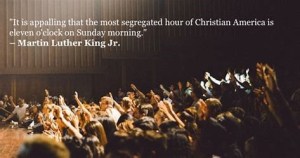
 “I think it is one of the tragedies of our nation, one of the shameful tragedies, that 11 o’clock on Sunday morning is one of the most segregated hours, if not the most segregated hour, in Christian Americas.” (Rev. Dr. Martin Luther King, Jr. on Meet the Press, April 17, 1960).

Nearly 60 years after they were first uttered, King’s words still ring true – Sunday morning is still a time when, if we look to our left and our right, we see people who look a lot like us.

The same was true in the early church. While the Jews had pretty good reason for keeping to themselves (the surrounding culture was often hostile and Jewish religious tradition was strict and exclusive), when Jesus stepped on the scene, He turned all of that upside down. His disciples often found Him drawing close to people who were very different from Himself. And when the Holy Spirit filled the hearts of believers in the book of Acts, they were led, albeit begrudgingly, to table fellowship and covenant relationship with those outside their community.

Why? Scripture tells us that when God first blessed Abraham and promised to build a great nation, God did so for the purpose of all the nations of the earth to be blessed through him (Genesis 12:3 & 22:18). God’s blessings were for sharing not for hoarding. But I think there is another reason. The power of the gospel can arguably be boiled down to one word: reconciliation (both with God and with one another). And God’s power to reconcile is often put most ostentatiously on display for an onlooking world in what I like to call, “only God” relationships. Those are the connections where it’s almost immediately obvious that ONLY GOD could have brought them together. And, as one who has partaken in an abnormally high number of “only God” relationships over the last ten years, I’d venture to say that they can also be, for the believer, some of the most rewarding.

Now, it is true that minoritized communities in the US have so few culturally safe spaces and, as a result, church often serves as one of the few we do have. And the unique idiosyncrasies of various cultures should be expressed in our corporate worship. (Remember, God celebrates differences!) But the mission of God hasn’t changed. We are still called to the nations to bear God’s glory. And how honored is God if we will go to nations all around the world, but refuse to welcome and engage the nations that God has gathered around us at home?

Prayer:  Gracious God, thank You for the reconciliation You made possible through the death and resurrection of Jesus. Help me to live into the fullness of all that reconciliation affords. Open my eyes to see the people You’ve placed in the community around me today, and help me begin to dream of what it would mean to enjoy deep and meaningful fellowship with them. In Jesus’ name. Amen. 

Bible Reading for Today: John 16


Lunch Break Study

Read Luke 10:25-37 (NIV): On one occasion an expert in the law stood up to test Jesus. “Teacher,” he asked, “what must I do to inherit eternal life?” 26 “What is written in the Law?” he replied. “How do you read it?” 27 He answered, “‘Love the Lord your God with all your heart and with all your soul and with all your strength and with all your mind’[c]; and, ‘Love your neighbor as yourself.’” 28 “You have answered correctly,” Jesus replied. “Do this and you will live.”

29 But he wanted to justify himself, so he asked Jesus, “And who is my neighbor?” 30 In reply Jesus said: “A man was going down from Jerusalem to Jericho, when he was attacked by robbers. They stripped him of his clothes, beat him and went away, leaving him half dead. 31 A priest happened to be going down the same road, and when he saw the man, he passed by on the other side. 32 So too, a Levite, when he came to the place and saw him, passed by on the other side.33 But a Samaritan, as he traveled, came where the man was; and when he saw him, he took pity on him. 34 He went to him and bandaged his wounds, pouring on oil and wine. Then he put the man on his own donkey, brought him to an inn and took care of him. 35 The next day he took out two denarii[e] and gave them to the innkeeper. ‘Look after him,’ he said, ‘and when I return, I will reimburse you for any extra expense you may have.’ 36 “Which of these three do you think was a neighbor to the man who fell into the hands of robbers?” 37 The expert in the law replied, “The one who had mercy on him.” Jesus told him, “Go and do likewise.”

Questions to Consider

Because this is such a familiar passage, let’s “study” it a little differently. Before we answer each question below, read the passage and place yourself within the story as one of the characters.

  1. Read through Jesus’ story and imagine yourself as the priest, then as the Levite. What are some reasons each one may have crossed over to the other side? If Jesus were telling this story today, who would these characters be? What would it look like for them to “cross over to the other side” today?
  2. Read the story again and imagine yourself as the Samaritan. Why did he stop to help the man? What can we learn from this? Imagine Jesus telling this story today. What would it mean for someone to show this extent of kindness to a person in need?
  3. Finally, read this story one more time, imagining yourself as the wounded person. How would you have felt in his situation? How would you feel as both the priest and the Levite pass you by? What would it mean for you to be welcomed and cared for by the Samaritan after all you’d been through? Who are the people in your life who’ve been a good neighbor in your time of need?
  4. Who do you most identify with in this story? Remember the gospel – that we were wounded and needy when Jesus came to our aid – should help us to empathize and identify with the wounded traveler. How does remembering your need help to cultivate mercy in your heart toward others?

Notes

  1. The priest was the one responsible for mediating between God and the people of God. The priest was literally a professional care-giver and servant-leader for the people before God. If anyone should have helped, the priest should have. The Levite “was a less likely person to offer help since his duty, assuming he fulfilled it, involved just assisting the priests in the mundane affairs involved in worship.” (Constable) While not the priest, the Levite is the next best thing and certainly should have stopped to help the wounded victim.
  2. The Samaritan is the only person that helped. We don’t know where he is coming from or where he is going. We also don’t know much about his social status or family background or what kind of resources he had (other than the fact that he had two denarii). All we know is that he has resources of some kind, and he is willing to leverage them to help a person who needs it. And we can speculate about why the priest and the Levite didn’t stop, but the only reason Jesus says this man stopped was “because he had mercy” (not because he was rich, not because he was holy, not because it was the right thing to do).
  3. We know nothing about the person who was wounded. All we know is that this person was on a journey and violently attacked, wounded and robbed. We don’t know if he was a nice person, if he was responsible, if did anything to contribute to his scuffle with the bandits, etc. We just know he is hurting and in need.
  4. Personal reflection.

Evening Reflection

One of my favorite theologians, Dr. Willie Jennings, often says that in the book of Acts you always find the Holy Spirit leading believers to people they don’t desire and to places they don’t want to go. He also explains that one huge problem in the Christian imagination is that for hundreds of years we’ve forgotten that we are the ones God included. The Jews were the chosen people with their own community and the Gentiles were outsiders. But God cared enough about us to push the Jewish believers outside their comfort zones so that we could hear the Good News and be saved.

Spend time this evening reflecting on the sentiments above. What does it mean for you that you are a person who was included? Who are the people or people groups in your life and community who are “outsiders” (for you and/or your church community)? What would it look like for them to be included into your life? What would it mean for you to be a neighbor to them? What, if anything, is keeping you from living out the radical reconciliation of the gospel in these relationships?